
2026 Ohio Active Transportation Conference Panels
Greater Ohio Policy Center (GOPC) is excited to announce the panels that will be featured at the 2026 Ohio Active Transportation Conference on Wednesday, September 2, 2026.
These sessions, developed with the support of our Advisory Committee of active transportation experts, aim to provide attendees with the latest on bike and pedestrian infrastructure, funding and financing for complete streets infrastructure improvements, successful strategies for educating the public, and more.
Eight one-house session will be scheduled throughout the day, and fall into one of three categories to provide in-depth information for attendees: infrastructure, engineering, and design; data, policy, and advocacy; and engaging stakeholders.
Conference Schedule
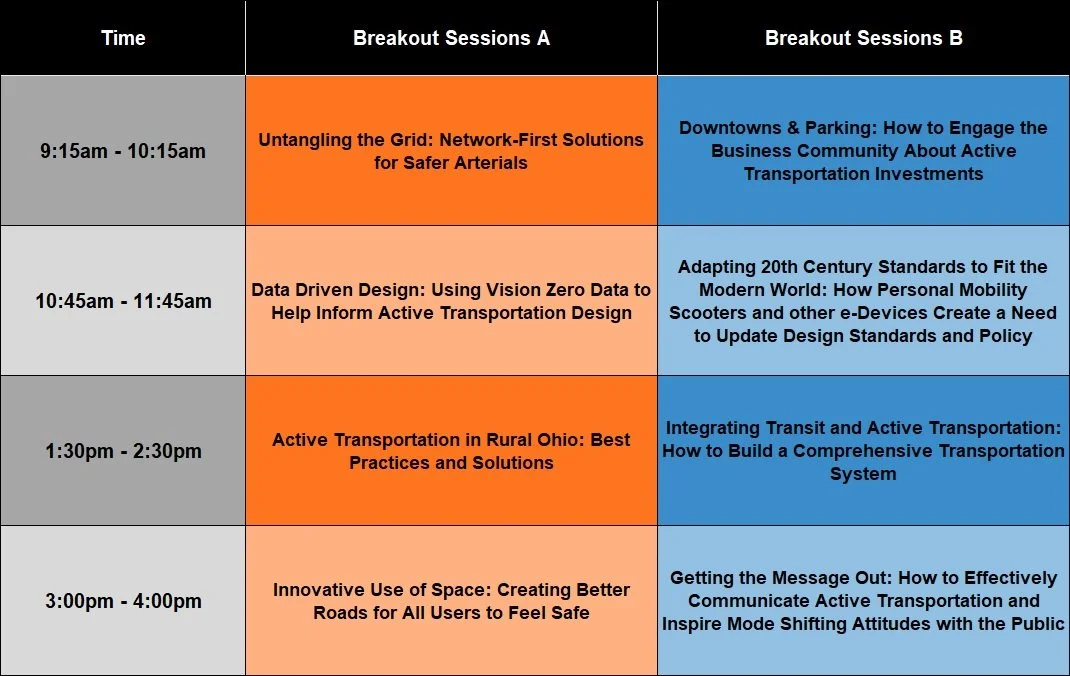
Session I: 9:15am - 10:15am
Untangling the Grid: Network-First Strategies for Safer Arterials
Ohioans increasingly desire walkable, livable streets, yet many local transportation networks have not rebalanced speed, safety, and access. While lane reductions have improved lower-volume streets, high-volume arterials and intersections often remain unsafe because the street network has not be modified yet. This session shows how to move beyond isolated corridor projects by analyzing transportation networks to identify bottlenecks and “knots in the hose” that limit design options. Through interactive case studies, Toole Design staff will demonstrate practical methods for evaluating networks, estimating lane needs, and redistributing traffic without sacrificing access.
Confirmed Panelists (click for bios)
Mariel Colman, PE, AICP, Toole Design Group (Moderator/Facilitator)
Jalen Miller, Toole Design Group
Dan Starkey, PE, Toole Design Group
Downtowns and Parking: How to Engage the Business Community about Active Transportation Investments
One of the biggest obstacles communities can face when proposing new active transportation projects is pushback from businesses that worry their sales will suffer if parking is moved or removed. Instead of fighting with business owners who are concerned with their livelihood, what can planners and advocates do in order win the support of these important community members? This session will focus on how to engage with the business community when an active transportation project or plan is on the drawing board, addressing the needs, wants, and desires of everyone who seeks vibrant spaces that can accommodate all mode users.
Confirmed Panelists (click for bios)
Chris Hermann, FAICP, MKSK
Betsy Pandora, MCRP, CTA, Short North Arts District
Jodie Perry, Mayor of Mansfield, Ohio
Erica Spaid Patras, Greater Ohio Policy Center (Moderator)
Session II: 10:45am - 11:45am
Data-Driven Design: Using Vision Zero Data to Help Inform Active Transportation Design
Vision Zero is a global, data-driven strategy to eliminate all traffic-related fatalities and severe injuries beginning with the acknowledgement that humans will inevitably make mistakes. Cities across Ohio have adopted Vision Zero policies to promote roadway safety. State and local governments are tracking roadway users, crash statistics, and other data. Understanding how to use this data to implement and inform the design of transportation infrastructure is an ongoing process. This session will examine how data collected as a result of Vision Zero policies can inform better roadway design, making roads safer for all users of transportation infrastructure, including vulnerable road users.
Confirmed Panelists (click for bios)
Jordan Petrov, Mid-Ohio Regional Planning Commission
Cameron Roberts, AICP, City of Cleveland (Moderator/Facilitator)
Jeremy Thompson, PE, Ohio Department of Transportation
Adapting 20th Century Standards to Fit the Modern World: How Personal Mobility Scooters and other e-Devices Create a Need to Update Design Standards
E-bike use has grown rapidly across the United States and in Ohio, and the market is expected grow by another 15% in the next 5 years. This growth represents a major opportunity to reduce car dependency, as research shows e-bikes are replacing vehicle trips for everyday travel. At the same time, communities are experiencing a rise in crashes involving e-bikes, particularly among younger riders. Although Ohio does not track e-bike crash data, local reports suggest safety concerns are increasing. This session will explore how planners, engineers, and policymakers can support the continued growth of e-mobility while improving safety through updated roadway design standards, modern infrastructure, and local and state policies that better accommodate e-bikes and other emerging transportation technologies.
Confirmed Panelists (click for bios)
Aaron Clapper, Greater Ohio Policy Center (Moderator)
Matt Lindsay, Miami Valley Regional Planning Commission
Steve Magas, The Bike Lawyer
Jean-Ellen Willis, PE, CSSBB, City of Dublin
Session III: 1:30pm - 2:30pm
Active Transportation in Rural Ohio: Best Practices and Solutions
Active transportation is often viewed as an “urban issue,” with people in cities and suburbs more likely to look at “transportation alternatives.” However, communities throughout Ohio, including rural Ohioans, rely on non-motorized transportation as a part of daily life. Additionally, the growth of bike tourism resulting from increased availability of recreational trails and the expansion of the state and national bike route system are challenging the notion that active transportation is an urban “luxury.” This session will look at best practices and innovative solutions for rural communities. Panelists will discuss context-appropriate multi-modal transportation options, including for Ohio’s Amish residents, as well as opportunities created by the bike tourism industry.
Confirmed Panelists (click for bios)
Zoie Clay, OSU Extension
Jennifer Eggleston, OSU Extension (Moderator/Facilitator)
Olivia Toth, Knox County Convention & Visitors Bureau
Christopher Young, PE, PS, Holmes County Engineer
Integrating Transit and Active Transportation: How to Build a Comprehensive Transportation System
In transportation planning, the biggest challenge is often sufficiently designing for the “first mile” and “last mile” of the journey from the transportation hub to the final destination. This is especially true for public transit users, many of whom lack access to motorized transportation options or cannot safely drive themselves. Active transportation—including walking, biking and scooting—can help bridge this gap in the transportation system, yet integration into existing networks can be a complex, costly process. This session will spotlight how one community is layering active transportation infrastructure into existing transit networks and infrastructure, including integrating active transportation with public transportation, connecting the last mile, and regional shared mobility programs.
Confirmed Panelists (click for bios)
Muriel Bowen, Greater Cleveland Regional Transit Authority (Moderator/Facilitator)
Mike Borger, AICP, Verdantas
Sara Byrnes Maier, Cleveland Metroparks
Annie Pease, Cuyahoga County
Session IV: 3:00pm - 4:00pm
Innovative Use of Space: Practical Innovations and Updates for Active Transportation
Vulnerable road users continue to face challenges navigating communities across Ohio. Between 2020 and 2024, there were over 4,100 reported crashes in Ohio that resulted in death or serious injury for a pedestrian or cyclist. However, places ranging from urban centers to rural communities are improving on old ideas to make roadways safer. Rightsizing infrastructure, replacing sidewalks with multi-use paths, and speed tables to slow down traffic in residential neighborhoods, are some of the approaches that are showing success. This session will feature a panel of experts with practical, real-world experience, including local government officials, planners, and engineers who have worked on these challenges. Panelists will discuss the solutions communities are implementing.
Confirmed Panelists (click for bios)
Kelly Kraus Mencke, KM Communications, LLC
Michelle May, May Day and Associates (Moderator)
Paige Wright, PE, City of Hilliard
Jenna Thomas, Bike Cleveland
Getting the Message Out: How to Effectively Communicate Active Transportation and Inspire Shifting Attitudes with the Public
A changing transportation culture requires more than infrastructure. From road diets to bike lanes, building public support for “new” types of infrastructure can be difficult. This session will feature panelists who have experience working with and educating the public on the benefits of active transportation infrastructure and how this change can have a positive impact on riders, walkers, and drivers.
Confirmed Panelists (click for bios)
Sarah Davis, City of Cleveland
Renee DeFord, Ohio Department of Transportation
Alison Goebel, Greater Ohio Policy Center (Moderator)
Tami Ruhl, Knox County Health Department
Note: Schedule and panelists are subject to change at any point prior to the conference.
Get the latest information about these exciting sessions, including panel descriptions, panelists, and the full conference schedule when you sign-up for updates.