
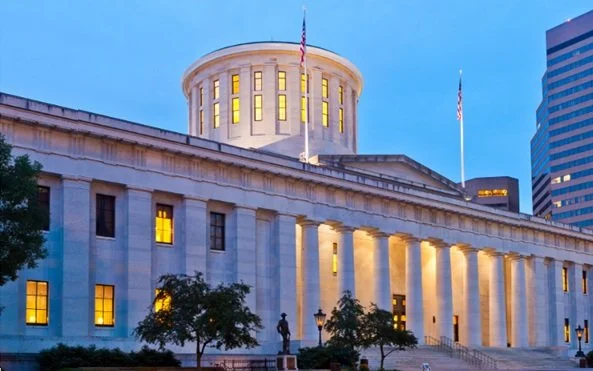
Last week, Ohioans voted to elect a new slate of statewide leaders.
Beginning on January 11, Ohio’s statewide leadership will include:
Governor Amy Acton
Lt. Governor David Pepper
Secretary of State Allison Russo
Attorney General John Kulewicz
Auditor of State Frank LaRose
Treasurer of State Seth Walsh
Also elected on Tuesday were members of the Ohio General Assembly. The membership of the 137th General Assembly which takes office on January 3 will be substantially different from the current 136th General Assembly. While there are still 4 races that remain too close to call (and will likely come down to provisional ballots and/or recounts), legislative Democrats have picked-up 8 seats in the Ohio House of Representatives and 2 seats in the Ohio Senate.
The pick-ups in the Ohio House are enough to break the legislative super-majority, which means that the next legislature will not have enough votes to override any vetoes from Governor-Elect Acton without needing to gain the support of Democrats in the chamber.
Likewise, the lack of a one party super-majority also means that the legislature cannot place ballot measures before voters without the need for bipartisan compromise.
Lame Duck Session Begins
All of this will take place in early 2027. Before then, the end of the campaign will also bring about Lame Duck Session. Lawmakers are set to return to Columbus on November 9 for committee hearings and have voting sessions scheduled weekly through December 17 (with a break the week of Thanksgiving).
Lame Duck is expected to be a marathon, with a number of issues left to be resolved. What else emerges as an issue will be determined by the outcome of the election. Due to their diminished legislative majority, there could be some issues which are pushed forward that returning Republican lawmakers may not be able to pass in the next session.
This is expected to be enhanced due to the loss of the super-majority and the belief that some bills will not sustain a veto by Governor-elect Acton.
There has also been some chatter about lawmakers working to remove some executive power away from the governor’s office and shifting those to the legislature, such as appointments, executive authority, and appointment powers to state boards and commissions - all actions which currently fall under the Governor’s purview.
Those changes would need to be approved by the current Governor, Mike DeWine, who has suggested that he would be opposed to those changes.
Bills GOPC is Tracking
There are a number of bills GOPC will be actively monitoring during the upcoming lame duck session, including:
Single Family Housing Tax Credit: House Bill 765 (White, Young) would modify the affordable single-family home credit.
The bill is positioned for a vote in the House Development Committee. Sponsor Andrea White lost re-election on November 3, and joint sponsor Tom Young in trailing in his race. These factors may move-up the likelihood of passage.
Gus Frangos Act: House Bill 86 and Senate Bill 102 are known as the Gus Frangos Act, after the late Executive Director of the Cuyahoga County Land Bank and longtime advocate for county land banks. Both bills, which have passed their respective chambers, would make changes to the law related to tax foreclosures and county land banks.
Both bills have passed their respective chambers. HB86 is sponsored by Rep. Steve Demetriou, who lost a bid for election to the Ohio Senate on November 3, possibly increasing the chances that HB86 becomes the vehicle for passage of the bill.
Building Inspections + Zoning Updates Act: House Bill 361 (Lorenz, Fischer) would reduce barriers to residential development by allowing local governments to utilize third party building inspections, establish “shot clocks” for plan and zoning reviews, and other adjustments to support development.
Joint sponsor Rep. Brian Lorenz lost his re-election bid on November 3, something which could factor in to whether HB361 moves in the limited time remaining in the session. The bill has not been passed by committee.
Promised Land Act: Senate Bill 250, would authorize nonrefundable, transferable tax credits for charitable organizations that construct owner-occupied housing.
Sen. Michelle Reynolds lost her re-election bid on November 3, something which could factor in to whether SB250 moves in the limited time remaining in the session. The bill has been reported by committee.
Build Smart Act: Senate Bill 428 would, among other changes, modify the residential building code and various other laws to apply the residential building code and other laws to four-family dwellings, permit certain buildings to have a single stairway exist, and other updates designed to help to lower the cost of development while maintaining appropriate safety standards.
Sen. Michelle Reynolds lost her re-election bid on November 3, something which could factor in to whether SB428 moves in the limited time remaining in the session. The bill has not been reported by committee.
MPO Reform Bill: House Bill 445 (Dovilla, Stewart) would make changes to regional councils of government and metropolitan planning organizations.
Rep. Mike Dovilla, the lead sponsor of the bill, lost his re-election bid on November 3. HB455 is already scheduled for a hearing on November 10 in the House Local Government Committee, and appears to be on the move towards passage during the session.
Data Center Study Commission: House Bill 646 (Click, Deeter) which creates the Data Center Study Commission. The bill had been poised for passage during the lame duckling session in June but cross-chamber battles around tax provisions within the bill prevented its passage. It could be resurrected during lame duck session.
Ohio voters voiced their strong opposition to data centers on November 3. 18 communities voted on curbing or banning center center development, with all 18 approving the measures. The strong public backlash against their development should spur the legislature to take action of HB646 or other measures aimed at addressing public concern with their development.
Be sure to follow GOPC social media channels and watch our online Bill Tracker for updates on these and all other bills currently pending in the Ohio General Assembly.
Note: All bills remain actively pending until the official end of the 136th General Assembly, which concludes at midnight on December 31, 2026.