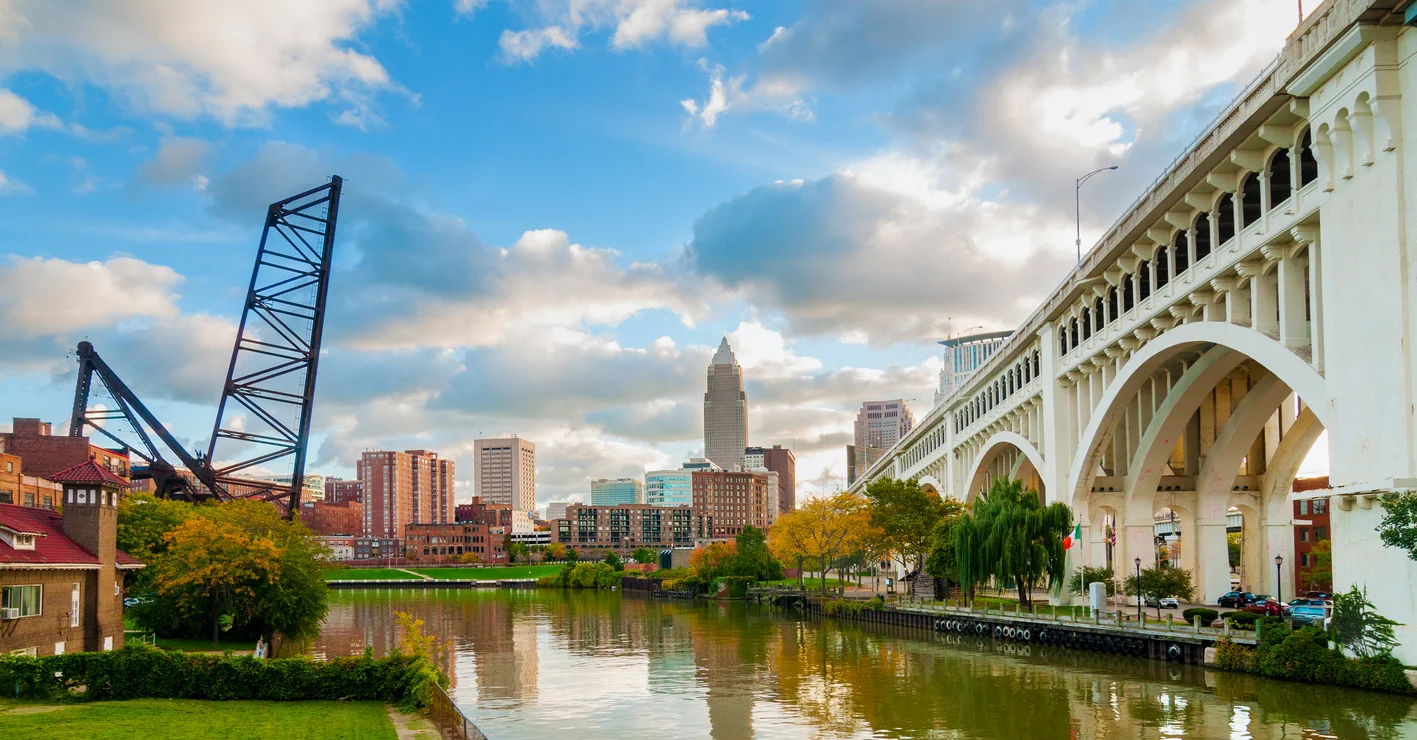
Regionalism is in the air in Ohio

Regionalism, one of the Restoring to Prosperity's major pillars, is receiving more attention as the economy shrinks and companies are researching new ways to streamline production and identify a work force for developing industries in the area. Not only are manufacturers across the nation interested in regionalism as a way to move their production closer to the customers which will dramatically cut costs (see Reuter's' article, "Manufacturing execs see more regional approach", Ohio and Pennsylvania counties are trying to reap its benefits as well. Counties in the two states realize that they are interconnected and have formed the Interstate Region Collaborative in order to study workforce patterns and match worker skills to the industries already there. "the Interstate Region group has received a $250,000 grant from the U.S. Department of Labor. Those funds have been used for study and development of a plan that includes such areas as trends in the five counties, industry analysis, an understanding of the local labor market and educational infrastructure." (Read the full article)

The changing economy demands that we looks at new ways to do business in Ohio and the Interstate Region Group is the first step in doing so.

Does Cleveland have a sensible plan to shrink?

Interesting comments on the blog, Brewed Fresh Daily, about Cleveland and its strategic plan.

The same question arises in Detroit:

  • Commentary: Will next mayor continue Detroit’s death spiral?
  • Cleveland can look to Youngstown…where the city has developed an international reputation for confronting reality and finding opportunity.

  • Smaller is Better for Youngstown, Ohio
  • The Incredible Shrinking City
  • In regional economic development, demography defines your trajectory.

    The Greater Cleveland Partnership, some years ago, published a strategy named Cleveland on the Edge.

    But “Edge of what?”

    Responses to “Does Cleveland have a sensible plan to shrink?”

    Click here to read the responses

    Federal Policies that will effect Ohio- what can you do?

    Two weeks ago, Greater Ohio attended the Revitalizing Older Cities -Capitol Hill Summit in D.C. in order to meet with fellow activists, community organizers, civic leaders, elected officials and to explore case studies, exchange ideas, and communicate to Members of Congress the message that the overall health of our nation is measured by the health of our cities. Jennifer Vey, from the Brookings Institution gave a compelling presentation on the "Role of Federal Policy in the Rejuvenation of Older Industrial Cities" (pdf). Other topics discussed included: Water Infrastructure; Vacant/Abandoned Properties and Brownfields; Innovation; Transportation;  and Job Growth. View the presentations.

    As the federal stimulus package is distributed, it is vital that Ohioans impact federal policies in ways that give the state the greatest ability to use stimulus dollars to invest in sustainable, growth projects. Below is a list of actions that you can take to impact federal policies that effect state revitalization:

    A Federal Legislative Agenda for Revitalizing Older Cities:

    Transportation:

    • HR 5951/S 2686 Safe and Complete Streets Act of 2008 was a bill introduced last year by Representative Matsui (D-CA) and Senator Harkin (D-IA) that would ensure that all users of the transportation system, including pedestrians, bicyclists, and transit users- including children, older individuals, and individuals with disabilities- are all able to travel safely and conveniently on streets and highways. The legislation encourages the use of non-motorized transportation modes, a key factor in creating healthier, more livable cities.

    Housing:

    • Support additional federal action to stop foreclosures and to give more resources directly to cities, particularly those cities and towns struggling with foreclosures and abandoned properties prior to the most recent wave of foreclosures.
    • HR 1033/ S 584 were introduced last year by the late Representative Stephanie Tubbs Jones (D-OH) and Senator Blanche Lincoln (D-AR). Enhancing the historic rehabilitation tax credit provisions make them work better with the low-income tax credit. This will further the use of older buildings for affordable housing. This bill will create an incentive for the redevelopment of our city’s architectural treasures and stimulate housing options for less fortunate families at the same time.
    • HR 2075 and S1239 introduced last year by Representative Richard Neal (D-MA) and Senator John Rockefeller IV (D-VW) these bills would extend the New Markets Tax Credit. This tax incentive has been a very successful mechanism in channeling investment dollars to neighborhoods most in need. Past projects that utilized New Markets Tax Credit funding have provided housing choices, stimulated local economies, and significantly reinvigorated challenged communities. HR 2075 and S 1239 would reauthorize the program until 2013.

    Water Infrastructure:

    • In order to meet the water infrastructure needs of our nation, Congressman Blumenauer is proposing draft legislation to create a Water Trust Fund. The mission of this trust is to provide a deficit-neutral, consistent and fire-walled source of revenue to states to support the replacement, repair, and rehabilitation of clean and drinking water infrastructure. The overall federal government contribution to total clean water spending has shrunk from 78% in 1978 to 3% today. The GAO, the U.S. Environmental Protection Agency, the Congressional Budget Office, and the Water Infrastructure Network, have estimated that the nation faces a growing water infrastructure funding gap of between $300-50 billion between what is currently being spent and what must be spent over the next 20 years in order to upgrade our again water infrastructure.

    Vacant Properties and Brownfields:

    • Representative Tim Ryan (D-OH) is introducing The Community Regeneration, Sustainability, and Innovation Act of 2009. This bill would encourage and test innovative vacant property reclamation and urban infrastructure renewal strategies in older industrial cities and metropolitan areas with a history of severe population and job loss. This bill would address blight and decay caused by abundant brownfields and vacant properties, and would provide tools for new strategies.
    • HR 2080 creates a new tax credit to assist states and local governments to clean-up contaminated industrial lands that pose threats to public health and our local economy. Even with state incentives designed to encourage the redevelopment of brownfields, thousands of acres of brownfields remain idle. Federal incentives to bring private dollars to these problem areas would be a significant step toward patting these brownfields back into sage and productive use.

    Economic and Workforce Development:

    • S 3078 -introduced in the last Congress by Senator Susan Collins, the National Innovation and Job Creation Act of 2008 establishes in the Executive Office of the President a National Innovation Council, to be responsible for formulating and advocating for the federal government’s innovation policy. The bill requires the Council to collaborate with major statistical agencies, collect data concerning the impact on productivity of the council’s programs, and annually report to Congress on national innovation and productivity. S 3078 places the Council under the direction of a National Innovation Council Board.

    Green Jobs and Sustainable Cities:

    • Introduced by Representative Perlmutter (D-Co) last year, H.R. 6078, the Green Resources for Energy Efficient Neighborhoods Act of 2008 or the GREEN Act of 2008 set provisions concerning Housing of Urban Development (HUD) energy efficiency and conservation standards and green building standards for structures (conservation standards). The bill requires the Secretary of HUD to conduct a program to demonstrate the effectiveness of funding a portion of the costs of carrying out energy efficiency and conservation and green building measures for multi-family housing projects for which rental assistance is provided under a covered multi-family assistance program. H.R. 6078 amends the Housing and Community Development Act of 1992 to provide for credits for Fannie Mae and Freddie Mac for mortgage Association Charter Act, the Federal Home Loan Mortgage Corporation Act, and the Federal Home Loan Corporation Act, and the Federal Home Loan Bank Act to include provisions concerning energy-efficient mortgages and location efficient mortgages.

    Where are we really going with transit?

    Recently, transportation has been the topic de jour. There is constant talk about implementing mass transit in Ohio but the actual plans continuously change. Will be put transit throughout the 3-C Corridor? Will it go along I-80/90 to link Ohio with Chicago and New York City? Should we focus on light-rail for our city areas? On top of that we are dealing with fiscal constraints that make implementation/construction difficult. Should charge a higher gas tax to pay for our infrastructure, rewarding those people who drive fuel efficient cars or should we start charging a mileage tax and punish those who drive the most? For more debate on this see the TransportPolitic's posting "A Mileage Tax in Question" The conversation for transit seems convoluted and in constant flux. And, looking at a chart (see below) that was presented by Chester Jourdan, Executive Director of MORPC, Ohio has never been clear as to its policy towards transportation.

    The history of mass transit in Columbus, Ohio

    The time is now to clear up the conversation and start to move in a strategic, path. Greater Ohio's Gene Krebs argues that a sensible path to move on passenger rail construction is to look at commute sheds. High density commute sheds have the greatest need for mass transit and that is wehre we should start. Hear more of Gene's comments at WCBE's website.

    Ohio Rocks...and here is why

    The Ohio Business Development Coalition Blog met with business leaders around the state in order to compile the positive attributes of our great state. Here is what they came up with:

    Ohio Business Leaders Discuss State’s Best-Kept Secrets

    February 19th, 2009

    Over the past year-and-a-half, I’ve spoken with Ohio business leaders and executives from across the state. Each shared with me their “best-kept” Ohio secrets. From these conversations, I’ve compiled my list of Top 10 Ohio’s Best-Kept Secrets.

    1. Home. Small-town feel with all the benefits and resources of a major city. In addition, short commutes to and from work make time for you to pursue personal passions.
    2. Low cost of living. You can have more house while providing your family with a balance of culture and some of the best public and private schools around.
    3. Excellent education. From preschool to higher education, Ohio is graduating students that will lead the world in business development and innovation.
    4. Central location. It’s easy to conduct business around the state with six international airports and 600 miles within 60 percent of the U.S. population and 50 percent of the Canadian population.
    5. Industry leader. Ohio is a leader in innovation and home to many great industries – agribusiness, automotive, bioscience, logistics, manufacturing, polymers, energy and aviation, and professional/financial services.
    6. Talented workforce. Ohio offers a diverse and talented labor pool of workers in a variety of key industries.
    7. Profitable business environment. Ohio’s business environment is designed to promote business development and entrepreneurship. The state has many strong workforce training programs and innovative job-creation and worker-retention programs such as the Ohio Third Frontier Project and the EnterpriseOhio Network.
    8. Lowest cost in the Midwest. Ohio is executing tax reform to substantially lower the cost of doing business in the state – with the lowest taxes in the Midwest by 2010.
    9. Strong supply chain. A strong supply chain across numerous key industries helps improve company efficiencies and profits.
    10. You can make a difference. In Ohio, you can make a meaningful difference in your community because you are not simply a "small fish in a big pond."

    To sum it up: business leaders agree that when it comes to opportunities for business development, education, low cost of living, community impact, supply chain management and tax reform, Ohio truly is "The State of Perfect Balance."

    Manufacturing on the decline, but BioScience on the rise

    Although the outlook for Ohio and the nation has looked fairly dismal recently, there is some light on the horizon. The federal stimulus package promises to offer a boost to the state's economy, creating new industry, developing new transit structures and recreating Ohio's neighborhoods. While Ohio's share of manufacturing jobs has fallen by 8 percentage points since 1990, it appears that we are boosting our national profile as a BioScience innovator. According to Mary Vanac at MedCity News, not only has a record number of biomedical companies started up or moved to the state, primarily in Northeast Ohio, it is also helping to spur revenues, jobs and growth in other industrial sectors as it outsources work to "contract research organizations like Ricerca Biosciences in Concord Township and contract manufacturing organizations like Ben Venue Laboratoriesin Bedford." Read the full article

    Below shows the density of Bioscience Organizations throughout Ohio.

    Ohio bioscience companies, by region courtesy of BioOhio

    During these times of economic hardship, it is vital that we change the way we live, travel and do business in Ohio if we want to regain our place as one of the nation's economic powerhouses. Toward this effort, the Restoring Prosperity to Ohio initiative is keeping a watchful eye on the federal stimulus package and is making recommendations to state policies and programs that will allow Ohio's communities to revitalize and get the most bang for their buck.

    "Real Reasons for Rail" -Gene Krebs speaks at the Columbus Metropolitan Club

    Check out RetropolitanBlog, "Crap or get off the Crapper" for a Summary of the Event

    "Real Reasons for Rail"

    Gene Krebs, Greater Ohio, Bill Habig, Transportation Matters and moderated by Chester Jourdan, MORPC.

    Read Gene Krebs' speech below.

    Thank you for inviting me to participate here today. CMC does a wonderful service not just for Central Ohio but for all of Ohio.

    Before I begin I do want to explain that much of Greater Ohio’s thinking on the issue of transportation is shaped by the ODOT Task Force report but also by the work we are doing with the Brookings Institution and our Restoring Prosperity to Ohio Initiative.

    Ohio’s land use patterns are not economically sustainable, and are not environmentally sustainable.

    Combined with untenable growth patterns that necessitate car-dependent lifestyles, high transportation costs are cutting into Ohioan’s pocketbooks. In 2008, the range of the percent income spent on transportation in Columbus was between 21% and 45%. In 2000, even with cheap gas, it ranged between 19% and 37%. This is also making Ohio non-competitive in attracting jobs due to spatial mismatch.

    Ohio citizens are feeling the impact of these and other challenging trends, but the moment is right to reverse this path.

    The Restoring Prosperity to Ohio Initiative is a multi-year research, policy and stakeholder organization effort, by Greater Ohio, aimed at state reform to revitalize Ohio’s core communities & metropolitan areas.

    In order to promote its assets and alleviate its challenges, Ohio needs a “Competitive Communities” Strategy that strives to leverage the potential of core cities by: taking stock of communities’ assets; developing measurable goals to drive change; leveraging assets driving prosperity; encouraging “right-sizing;” and targeting state resources strategically. Greater Ohio’s primary focus is a place-based revitalization of the cities and towns that concentrate the assets that drive prosperity: Innovation, Workforce, Quality of Place, and Infrastructure.

    Today’s panel is about one of the four assets that drive prosperity: Infrastructure, and Investing to Promote a 21st Century Transportation System. Ohio must change the way it funds transportation and offer more options than highways and cars. Greater Ohio supports transit and other alternatives to highways and the creation of a Transportation Investment Bank. A change in transportation programming will also support regional economic growth and prosperity.

    In public policy we talk a lot about mission creep; that is where the policy has lost sight of its original intent and is now just serving its own needs - a Golem of sorts. People forget the policy was a means to an end and the policy becomes an end by itself. Transportation is guilty of that mistake. I am not referring to classic freight movement, but rather that, currently transportation in Ohio is about moving cars, and not people. We have forgotten the core mission; it should be about moving people, not cars. Cars are the means, not the end. The recent Task Force report, in its first three quarters, worked hard to bring back a people- centered transportation system to Ohio. We applaud those efforts. The last quarter, which focused on funding, is not economically sustainable.

    A recent poll by the National Association of Realtors and Transportation for America (T4America) concluded that an overwhelming 80 percent of Americans want the federal economic stimulus package to emphasize road and bridge repair and transit, not new road construction. At least 40 percent of overall transportation infrastructure spending should be targeted towards transit and intercity rail investments that will begin to build a green transportation network. Rail also has the lowest mechanical energy requirement of land movement, and according to a new study by Dr. Chris Nelson at Utah, transit generates by far and away the most jobs of all transportation projects, a third more than new highway construction, 17,784 jobs per billion dollars spent.

    History seldom repeats but it often rhymes. If you go to the Statehouse and stand in the middle of the Rotunda, and look straight up, you will see the state seal that existed when the Capitol building was erected. Floating at the bottom of the seal is a canal boat, thought to be the highest technology for transportation at that time.

    In summation, the cars we drive today are the canal boats of the future, it is not economically sustainable and we should be about moving people, not cars, and not canal boats.

    Once again, thank you.

    The Euclid Corridor in Cleveland & Transportation Priorities for a Changing World

    What would a Euclid Corridor type project look like, if it were implemented in your community?

    Transportation Initiatives in Ohio

    Euclid Corridor

    The Euclid Corridor project in Cleveland – now called the RTA Health Line – is an example of a transit investment that has stimulated urban reinvestment in a high-density corridor. It has good place-making attributes, and it supports the innovation of the University Circle “eds & meds” district. This district has several anchor institutions, including two universities, two medical centers, and a host of businesses and cultural institutions. It also provides a strong physical and aesthetic link between two important economic engines in the region - downtown and University Circle.

    Euclid Avenue used to be an eyesore with potholes, cracked paving and sunken sidewalks – now you can ride on custom designed bus rapid transit (or BRT), powered by a hybrid diesel-electric engine. BRT affords the dedicated right-of-way of light rail but the versatility of a bus. The new public art, bicycle paths, landscape designs, sidewalks and passenger stations are an excellent example of “complete streets.” Complete Streets is a growing movement in the U.S. based on the idea that a complete street – sidewalks, bike paths, median islands, curb extensions and more - balances safety and convenience for everyone using the road. (Read more about the Euclid Corridor.)

    The new bus stations designed by Robert Madison International of Cleveland for the new Euclid Avenue Health Line add to the city's urban landscape.

    Invest in a New Direction

    Euclid Corridor is now a national model that shows how smart investments in transit and public space can help struggling cities turn themselves around. It’s also an investment that is expected to help the community reduce its expenses and save money, ultimately freeing it from oil dependency and creating clean, green long-term jobs. We advocate similar priority investments that offer multiple pay-offs.

    A recent poll by the National Association of Realtors and Transportation for America (T4America) concluded that an overwhelming 80 percent of Americans want the federal economic stimulus package to emphasize road and bridge repair and transit, not new road construction. Transportation and development go hand in hand. Our nation can no longer afford to sink money into highway lanes or transit that become overwhelmed or undermined by poorly planned development. We need a more efficient system that rewards communities for developing in smarter, more sustainable ways, reducing energy use and carbon emissions while ensuring the availability of housing affordable to families of all incomes, near job centers and public transit. (Read more at http://t4america.org/blog)

    An earthwork was created at University Circle as part of Cleveland's new bus rapid transit line on Euclid Avenue.

    Also in Greater Ohio's February E-newsletter

    Greater Ohio applauds the bold initiative that the state is launching to plan for transportation in our changing world, as laid out in the Ohio’s 21 st Century Transportation Priorities report recently released by Governor Strickland’s Task Force on which Greater Ohio co-director, Gene Krebs, served as a governor-appointed member. Greater Ohio encourages policy recommendations that call for transformative infrastructure investments and align with our Restoring Prosperity to Ohio Initiative policy agenda, such as: aligning the policies and practices of state agencies; launching a Making Regions Matter initiative; expanding the use of alternative fuel technologies; and supporting “smart growth” solutions and public transit. (View the entire Ohio’s 21 st Century Transportation Priorities Task Force report here.)

    Make Transformative Infrastructure Investments

    But the federal economic stimulus package provides an unprecedented opportunity for Ohio to go beyond these recommendations and undertake truly transformative infrastructure investment projects -- investments that drive economic development when led in a way that directs funding to projects with the highest return for the future. Ohio’s projects must build off President Obama's plan to advance a stimulus package that ignites short-term economic growth but also puts the nation on the path to long-term prosperity, including a shift into the green economy.

    New Mexico's Rail Runner opened for service from Albuquerque to Santa Fe in December 2008 with peak ridership.

    Therefore, in Ohio we call for: (1) identifying "green" investments that will reduce vehicle miles traveled or carbon emissions in general, such as transit-oriented development; (2) upgrading existing urban and suburban roads -- including state routes that run through our cities (“fix it first”). At least 40 percent of overall transportation infrastructure spending should be targeted towards transit and intercity rail investments that will begin to build a green transportation network; and (3) requiring greater accountability and transparency by attaching performance criteria to infrastructure investments, so they are truly transformative in meeting economic, social, and environment/energy goals. Ohio’s plan must embody a new approach to funding transportation projects that aligns with that suggested here and the emerging federal perspective.

    Learn more at the Feb. 18 Columbus Metropolitan Club Forum

    Learn more about transformative infrastructure investments at the February 18 Columbus Metropolitan Club Forum, “Real Reasons for Rail,” featuring Gene Krebs, Chester Jourdan of MORPC, and Bill Habig of Transportation Matters. Register at www.columbusmetroclub.org.

    Is the 3C-Corridor a possibility in the near future?

    There has been much talk in Ohio about the construction of passenger rail along the 3-C Corridor. However, it seems as if we constantly hear about the proposed project but never see any action to make it a reality. The talk may finally turn into action however, as state policy makers become determined to implement the project by 2010. Xing Columbus highlights the the actions underway and what the route may look like as the project moves forward.

    However, it is likely that the feasibility of this project relies on the outcome of the federal stimulus package and how much money is given to states.