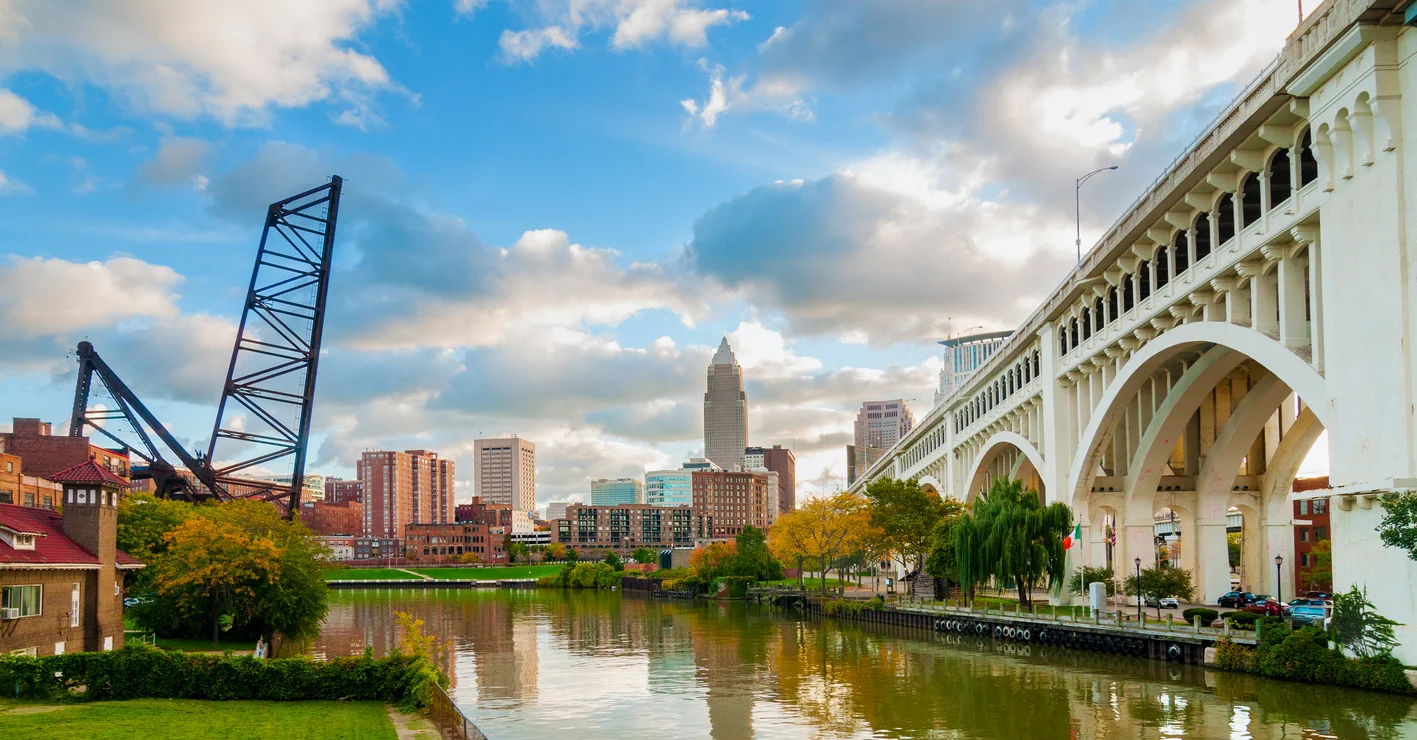
Planning the Next Life for Brownfields : Greater Ohio attends Brownfield Workshop

On Monday March 21st Greater Ohio attended a Brownfields Area-Wide Planning Workshop hosted by Ohio Department of Development and Smart Growth America.  The workshop brought together urban planners from Ohio and Michigan to discuss strategies for writing a successful application to a US EPA pilot program that supports the planning phase of brownfield and underground storage tank (i.e. former gas stations, etc.) remediation. Area-wide planning works at “area” scale—everything from one city block to a neighborhood to a multi-municipal corridor.  Area-wide planning acknowledges that even just one contaminated, post-industrial lot can impact an entire neighborhood, and it also enables communities to comprehensively plan for neighborhoods where multiple, non-contiguous, brownfield sites exist.  The US EPA pilot program was established to assist communities with the planning phase of brownfield redevelopment—the funds are being used to support brownfield inventories, build community buy-in through education and outreach, develop market analyses and other early-stage activities.

Presenters from the US EPA program and three successful applicants, including one from Cleveland, shared strategies for writing successful proposals.  All pointed to the need for a strong, comprehensive plan for the entire ”area”—essentially the brownfields planning program is just one of many strategies that will assist municipalities and nonprofits in the comprehensive revitalization of an neighborhood or corridor.  To this point, all three applicants had received additional monies from Department of Transportation or HUD for the same larger project, and many of the other successful applicants were using the area-wide planning monies for a full scale, long term, redevelopment program.

As a legacy of our manufacturing past, so many cities in Ohio now struggle with the assessment, cleanup and redevelopment of brownfields.  Luckily Ohio has a strong brownfields program through the Department of Development, which Greater Ohio has long supported.  Greater Ohio is heartened to see programs like the area-wide planning pilot coming from the federal level and supported by state programs because these kinds of programs incentivize and reward long term and comprehensive planning.  As Ohio continues to grow its metros, redeveloping brownfields and making them available for infill development will be a key activity in leveraging the competitive assets already located in Ohio’s cities.

Columbus 2050

In 39 years, will you love to live in Columbus? The Columbus chapter of the Urban Land Institute along with many central Ohio partners has launched a visioning and long-term planning initiative called Columbus 2050.  Throughout the process, ULI will ask central Ohio residents what they would like to see happen in the community over the next 39 years.  Several events with local experts are also scheduled for the coming year to inform the broader conversation.  In the end, this long-term effort will create plans for Columbus that reflect the needs and desires of the community and are sensitive to global and regional economic and demographic trends.  We applaud the effort to proactively plan for the Columbus region's future.  See the video below where local stakeholders, including Greater Ohio's Executive Director, Lavea Brachman, discuss the initiative.

Building Talent Through Internships

Last week, an editorial on the local news radio station caught the ear of several Greater Ohio staffers.  The commentator, Gail Martineau, highlighted several programs which are aimed at retaining college graduates in Ohio.  In particular, Martineau attributed internships programs as being one of the most important tools in the state’s arsenal. Research by Collegia, a higher education economic development consulting firm, confirms Martineau’s hunch: out-of-region students who interned in Philadelphia were twice as likely to stay in the city after graduation and undoubtedly, the number is higher for in-region students.  Although there are differences between Ohio’s shrinking cities and Philadelphia, similar retention rates likely occur.

Many of the internships listed on clearinghouses like EasyColumbus, NEOIntern in Cleveland, and SOCHE in southwest Ohio are located in cities.  This isn’t surprising actually because the state’s cities turn Ohio’s economic motor; the seven largest metros concentrate talent and innovation and contribute to 80% of the state’s GDP.

Cities like Akron and Springfield have recognized that to increase the number of local jobs and the city’s prosperity, education and workforce development will carry the metro into the next economy.  Internships will be one critical strategy as Akron and other Ohio cities continue to leverage their assets and prosperity drivers.  The state can play an important role in this process by supporting internships programs, as it does now with the Third Frontier Internship Program and the proposed funding for the Ohio Co-op and Internship Program.

Ohio has one of the largest collections of colleges and universities in the country— using internships to capitalize on the presence of so many young, eager, educated people not only brings fresh talent to businesses and gives students real-life work experience, but internships can also help retain the creative, highly-trained workers needed for the state’s long term competitive success.

The State of the State

By Gene Krebs. Like many Buckeyes, I am waiting for the budget to be released later today.  In the meantime, many have been poring over the recent State of the State speech by Governor Kasich and looking for clues.  I was pleased to see that the speech touched on many smart growth principles.

Some of the themes from the speech aligned with what we have been hammering on for seven long years.  The main one is that our metropolitan regions are central to restoring Ohio.  Governor Kasich emphasized this by drawing attention to the dramatic population loss of many of Ohio’s major cities.  “Cleveland and Youngstown have lost 50 percent of their population since 1950. Fifty percent of the population of Cleveland and Youngstown gone.  And I will take your breath away by telling you that the city where the north meets the south, Cincinnati, has lost 40 percent of its population since 1950.”  This acknowledgment of our shrinkage is an important first step to being able to diagnose and treat the problems we are facing.  This focus on cities also affirms Greater Ohio’s agenda.  I am glad to hear that cities and metros are getting the attention they deserve.

The State of the State speech also reflected a shift in attitude towards how we grow.  What does it all mean?  This could be an indicator of massive changes in how we govern, how we are organized, and how we spend.  These changes are likely coming as the state attempts to deal with our unprecedented budget shortfall.

It was also positive to hear that Governor Kasich supports governance reform and shared services.  As he said in his speech, “We are going to reform government, okay? It's going to happen. And I'm -- I'm asking you all to keep an open mind about the possibilities of reform because you can't keep doing the same thing in this state and avoiding the decisions that need to be made that have been put off for political reasons, frankly.”   Change certainly is needed for many reasons.  Ohio’s antiquated form of government was designed for the horse and buggy economy, not the global economy.  We need to reform in order to compete.

However, we hope that the change represents not just cuts in our spending, but also the right types of investments in our cities and metros as well.  Ohio needs to face the fact that cutting taxes and spending alone will not be the silver bullet.  And we have to acknowledge that our population loss is not due solely to high taxes.  We need to invest in order to build the kinds of quality places that attract businesses and skilled workers.  For further proof of this, see this letter from a Michigan CEO who wants to relocate out of Michigan not due to taxes or regulations, but because the sprawl endemic to his area creates undesirable places where talented, educated workers prefer not to live.

All in all, there were many positive signs, but there is a lot of work ahead of us, and the devil is in the details.  We look forward to seeing the budget later today in order to figure out the Governor’s proposed path of action.  Stay tuned for more of Greater Ohio’s analysis.

ODOT Report Released

Last Friday, March 11, 2011, Ohio Department of Transportation released a long-awaited report, "Financial and Policy Implications on Assuming Primary Responsibility for All State Routes Throughout Ohio Regardless of Local Government Jurisdiction" (at this time, the study is not yet up on the ODOT website). This report originates from a 2009 request from legislators of the 128th Assembly.  In 2009 it came to the attention of state senators and representatives that cities and towns in Ohio are financially responsible for the repair of all roads—including state routes—within their boundaries.  Unincorporated areas, like the rural townships in Morrow County and urban townships, like West Chester, do not have to pay for the maintenance of state routes; instead ODOT covers the repairs and fees.  This arrangement has had the unintended effect of producing roads that are full of potholes in a city but are smooth and well-repaired immediately beyond a city’s boundaries.

The same intersection on the edge of Youngstown.   Heading North on Market Street, State Route 7, into Youngstown, the street is potholed and patched over.

Headed South, through the same intersection into Boardman Township, Market Street is smoothly paved.

Having learned of this discrepancy, in 2009, legislators mandated ODOT to study the cost of maintaining all state routes in Ohio.  In effect, legislators wanted to know how much more it would cost if ODOT took responsibility for state routes in cities and towns, not just townships and unincorporated areas, as it does currently.

What ODOT concluded in its study is that current funding models would inadequately fund service to new areas.  Greater Ohio has also analyzed ODOT’s budget and does not disagree that ODOT has limited resources to fund new construction and repair obligations.

However, Greater Ohio believes ODOT, as it stands, barely has any resources to fund new or existing maintenance, period.  ODOT is currently funded with “state gas tax” dollars which takes 28 cents for each gallon of gas purchased.  As we trade in Hummers for Hondas and more and more alternative fuel cars come on line, state gas tax revenues are decreasing.  ODOT itself anticipates a $1.5 billion deficit by 2017 if current income trends and project levels continue.

Moving forward, ODOT will have to find alternative revenue streams if it is to repair any roads—in cities and villages, or outside of them.  As Greater Ohio has suggested in recent House and Senate hearings on ODOT’s budget, a thorough audit of ODOT may very well turn up millions of dollars, as similar audits have done in Virginia ($600 million in immediate savings) and Idaho ($30 million in one-time savings over five years, and $6 million annually thereafter).  Prioritizing maintenance of existing assets before the construction of new capacity will save money, as will funding new projects based on their return investment potential and should not favor one mode over others.

Greater Ohio will continue to closely monitor the transportation budget bills as they move through the General Assembly and offer, as appropriate, alternative funding models which will lead to sustainable, economically-competitive, transit development.

Land Bank Conference: June 5-7, 2011

Greater Ohio Policy Center's partner, Center for Community Progress, is hosting a Land Bank Conference in Detroit June 5-7, 2011.  Find out how to register for the conference here.

In many places across the country, land banking is becoming an integral part of community revitalization efforts, especially as America’s cities and towns have struggled to keep ahead of the foreclosure crisis and the resulting economic impacts over the past few years. Today more communities than ever are developing and strengthening land banking efforts to increase affordable housing, create market-based development opportunities, and implement alternative land reuses.

Participation in the 2011 Land Bank Conference will help you identify how land banking and tax foreclosure strategies can catalyze development of effective solutions to unlocking the value of vacant, abandoned, and problem properties.

The conference attracts hundreds of professionals from across the country and from diverse backgrounds including: elected officials, land bank staff and board members, for-profit and non-profit developers and the real estate industry, community foundations, greening initiatives, neighborhood and civic leaders, and local and state government officials.

The 2011 Land Bank Conference offers you two days of opportunities to build the effective skills and relationships needed to revitalize your communities, including:

  • Pre-conference training seminars
  • Twenty interactive breakout sessions covering a full range of issues related to land banking and tax foreclosure reform, including financing land banking operations, market-based strategies, vacant lot reutilization, and creating long-term affordable housing.
  • Two bus tours highlighting greening and redevelopment initiatives taking place in Detroit
  • Networking opportunities allowing you to exchange ideas with stakeholders from across the country.

Register by May 6 for just $150! We hope to see you there.

From Dry-Cleaning to Carry-Out Chicken: Antique Store Discovery Depicts Evolution of Ohio

These seven postcards, discovered in an antique store in Mt. Vernon, Ohio, depict the Acme grocery store franchise in Akron as it grew from the early to late twentieth century.  The postcards reveal significant changes in the architecture and built form of the United States and Ohio as well as dramatic changes taking place in the retail industry over the last hundred years. The first picture, taken in 1901, shows the second store in the grocery store chain.  The franchise steadily added stores through 1911 and the stores looked and were sited similarly, generally on a main street in a neighborhood-oriented commercial district often times near what look to be residential dwellings and other types of compatible uses.

1901

1910

1911

The cards now jump ahead 30 years to 1940, but during this time the franchise continued to expand; the 1940 store is the 83rd in the franchise.  This picture illustrates some significant changes in the building’s architecture and orientation with the neighborhood.  The store is now set back from the street to allow for parking and one can imagine the street where this store is located being more intensively commercial- and auto-oriented than the neighborhood-oriented commercial center of the early 1900s.

1940

By 1972, the architectural style has changed again, but the overall orientation with parking in front of the store is still the same.  Of note, however, is what the store is selling; it is no longer just a grocery, but instead is an Acme Y Mart, a chain of pharmacy and convenient stores.

1972

The 1980 store is a supersized version of the 1972 store with an even larger footprint and increasing area dedicated to  parking.

1980

By 1990, the store’s footprint is larger still.  Now it is a 220,000 square foot big box store with acres of surface parking in the front.  The additional square footage reflects a major change in what is sold inside.  The store is now an Acme Supercenter and the back of the postcard boasts, “With today’s busy schedule, the convenience of one-stop shopping is important to almost everyone.  We do it best: from dry cleaning to carry-out chicken, hardware to home fashions, pastries to prescriptions!”  With such a diversity of merchandise this super store draws customers from a decidedly larger region than the stores of eras past.  The need for so much parking also reflects this.

1990

The postcards stop in 1990, but we found this image is online of a current Acme store.  Wikipedia says that the franchise has once again changed its business model and returned to a focus on groceries with the introduction of the Acme Fresh Market line of stores.  Many of the super centers were closed and the older stores were sold to CVS pharmacy.

Current

At Greater Ohio, there are several reasons that we find these postcards interesting.  They visually document changes in the way we live and clearly show the increased influence of the automobile and its role in giving people the ability to travel from far distances, adjacent counties even, to shop and play.  They also show the related change in the retail industry that evolved from a corner store into a large format “one stop shopping” concept with a wide assortment of products on offer.  This contrast also illustrates why smaller neighborhood stores have struggled to compete with retail giants in recent decades.   Of course, the postcards also depict the dramatic changes in architecture and the built environment that went hand-in-hand with these market changes and shaped the visual landscape of our cities and towns.  Finally, this series of postcards underscores a more philosophical point that society is constantly changing around us and that we need to proactively acknowledge and embrace this change within our strategic plans and policies.

Source: http://en.wikipedia.org/wiki/Acme_Fresh_Market

Building a Stronger Future: Greater Ohio Speaks to the Columbus Chapter of the American Institute of Architects

On Tuesday evening Greater Ohio attended the monthly Columbus chapter meeting of the American Institute of Architects.  We spoke to over sixty architects—including private and public sector architects, landscape designers, and planners—about the Restoring Prosperity Initiative and how lessons learned from Europe can help Ohio and its metros compete in the next economy.  We shared with the AIA some grim statistics, including declining population numbers in our urban cores, large numbers of vacant and abandoned properties throughout the state, and numerous layers of local government. But we concluded our presentation with firm evidence that Ohio can compete in the next economy.  Ohio has incredible assets, such as “eds and meds” anchor institutions, and has policies, like Land Bank legislation which assists local communities in controlling and repurposing vacant and abandoned property. Ann Pendleton-Jullian of Ohio State University’s Knowlton School of Architecture followed Greater Ohio’s presentation and discussed—using studio projects from graduate seminars—the strengths inherent to Ohio’s physical and cultural landscape.  Pendleton-Jullian suggested Ohio’s location “in the middle” of the country and in the middle of the Midwest ideally positions Ohio to be central in next economy, which she sees as creative and innovative.  Pendleton-Jullian also pointed to Ohio’s incredible number of colleges and universities and the roles they will play in educating for the creative economy.  In further developing the mission of the state’s land-grant institutions as serving the state, Ohio is well positioned to develop an “educational ecosystem” which would greatly complement many of the policies for which Greater Ohio is advocating.

Greater Ohio looks forward to public forums like these because it gives us an opportunity to educate Ohioans about our mission and receive feedback on our research and policy recommendations.  We especially enjoy speaking events where dialogues develop between our work and other exciting programs which are also striving to grow Ohio’s economy and improve Ohioans’ quality of life.  Please do not hesitate to contact us if you would like us to come speak to your organization.

Transit in Ohio: A Missed Opportunity

In a recent post, we praised the national attention that cities are getting for the disproportionate role they play in spurring innovation, generating GDP, and several other factors.  In Ohio, we should be paying close attention to this discussion because Ohio is rich in cities and metro areas (broad regions that encompass what we traditionally think of as “cities” but also include economically interconnected suburbs and rural areas).  While this national conversation is heartening, on the local front, we have been disappointed to read several articles chronicling the minimization of public transportation as a priority in Ohio.  Transit, and its ability to support the development of walkable places, is an important element in fostering dynamic, sustainable cities capable of generating outsized returns.

  • The Ohio Department of Transportation recently announced that the state will cut $70 million from the $150 million pledged to state transit agencies under the former Governor.
  • A recent Columbus Dispatch article has an exaggerated title, but nevertheless chronicles the de-emphasis of Columbus’ long-studied plans for a streetcar and light rail.   This follows the news that Columbus’ proposed “Health-Education” line will not proceed due to the state’s reallocation of funds, mentioned above.  Although Columbus is economically prosperous compared with other Ohio cities, it cannot afford to be complacent and fail to provide the amenities that the talented, un-tethered workforce and empty-nesters are calling for: namely, high-quality transit and the vibrant, walkable neighborhoods it helps foster.  If this sounds quixotic, these actually are the findings of a Columbus Chamber of Commerce study on attracting and retaining talent in Columbus.  The report specifically called out the need for Columbus to improve pedestrian areas, public transit and revitalize downtown, proving that there is widespread support for transit in Ohio.

Photo from UrbanCincy.com

  • The Cincinnati Chamber of Commerce has also put their weight behind the Cincinnati streetcar (and future transit projects) by coming out against a burgeoning effort to oppose the streetcar, and saying the movement would “significantly hamper positive growth in Cincinnati.”  We are cheered by the support of the Cincinnati Chamber and the community for the streetcar, which has the potential to be the first of its kind in Ohio and has already demonstrated its merit by winning federal funding and defeating a similar initiative in 2009 (Issue 9) aimed at thwarting it.
  • While Cincinnati fights for their streetcar plan, they will not escape the previously mentioned state cuts to transit funding.  Urban Cincy reports that the funding was slated to be used for express bus service connecting the University of Cincinnati to Glenway Crossing, Butler County, and Uptown.

Nationally there is growing recognition that strong cities and their regions support lots of good things, like idea transfer, economic development, good health, and more.  If a city means opportunity, then in Ohio we’ve got opportunity in spades.  But we need to make strategic investments in our cities and metro regions to make them the kinds of places that people want to live and work.  Public transit is a key lever in this change because while it’s good for moving people around, it’s also good at coalescing quality places.  In Ohio, we must make an intentional effort to leverage our existing resources to their fullest potential and developing robust transit is one important way to do that.  If we do this right, the return on our investment will be significant.

The Buzz about Cities

Edward Glaeser's new book, Triumph of the City: How Our Greatest Invention Makes Us Richer, Smarter, Greener, Healthier, and Happier, has been generating a lot of buzz.

  • Last week New York Times Op-Ed Columnist David Brooks wrote an interesting article about The Splendor of Cities where he discusses the role that cities play in disseminating new ideas.  His argument stems from ideas brought forth in Glaeser’s new book.  Cities prosper due to their ability to offer face to face communication, which surprisingly comes to matter even more in the age of the internet.  The article explains that “Cities magnify people’s strengths […] because ideas spread more easily in dense environments. If you want to compete in a global marketplace it really helps to be near a downtown.”

  • On Monday Glaeser himself wrote a guest entry on the Freakonomics blog on the New York Times website.  His article, entitled To Get America Growing Again, It’s Time to Unleash Our Cities, offers the message that the key to economic development can be found in cities.  Glaeser claims that the secret to China’s success is its rapid urbanization, but luckily America is just as capable of investing in its cities too.

Glaeser's Book

  • Glaeser was also recently interviewed by NPR to discuss the ways in which cities are actually greener and healthier than the rest of the country.  In the interview he describes what cities need to do in order to successfully adapt and evolve in order to remain competitive.

  • Glaeser even discussed the need to support cities by curtailing many of our country’s anti-urban policies while appearing as Monday’s guest on The Daily Show.

Greater Ohio is pleased to see this conversation spreading across the country.  As stated in our report, Restoring Prosperity: Transforming Ohio’s Communities for the Next Economy, Greater Ohio recognizes that Ohio’s multiple metropolitan areas – fully encompassing urban, suburban and rural places – house the resources and drivers of prosperity necessary to lead the state of Ohio into the next economy.  But these resources and prosperity drivers need to be leveraged.

If you want to support Greater Ohio’s work to leverage Ohio’s metropolitan assets with improved state policies, please sign up to become a Greater Ohio Supporter, and learn what you can do to help.