GOPC Executive Director Expertise Recognized by Leading University

Lavea Brachman selected from nationally competitive pool to serve as Fellow at University of Chicago’s Institute of Politics. The Greater Ohio Policy Center is proud to announce that Lavea Brachman, Executive Director, will serve as a Resident Fellow at The University of Chicago’s Institute of Politics for ten weeks during the spring quarter, starting the end of March.

The University of Chicago Institute of Politics (IOP) Fellows Program provides opportunities for students to learn from practitioners about civic engagement, public service, and public policy issues.  Fellows, which include journalists, former elected officials, campaign strategists, and other experts in their field, “lead non-credit seminars on timely and relevant issues of national import.”

Lavea will teach a seminar that will focus on the challenges and future of older industrial cities.  During this time, she will have an opportunity to interact with other practitioners, academics and community leaders.

From March 28th until May 31st, Lavea will be in residence at the IOP and be taking a leave from her day-to-day responsibilities as GOPC Executive Director.  During this short absence, GOPC’s Deputy Director Alison Goebel will manage and oversee the organization’s day-to-day operations.  Lavea will remain available to staff throughout her two month Fellowship and will continue to advise on and contribute to certain on-going projects.

The GOPC Board and staff are thrilled for Lavea.  Her selection as an IOP Fellow is also a great honor for GOPC – reflecting on GOPC’s stellar work and expertise in this arena.

Connecting Neighborhood Revitalization to “Green” Water Infrastructure

By Colleen Durfee, GOPC Research Intern Stormwater runoff and Combined Sewer Overflows (CSOs) are primary concerns of Ohio’s industrial legacy cities. In the midwest, we have long depended upon natural water sources for city and metro water needs but severe weather patterns, decades of unsustainable development, aging infrastructure, and fluctuating populations damage natural hydrological systems by allowing human produced bypass and overflow to enter them without being treated. Because of this, many municipalities are faced with needing to upgrade sewer and stormwater infrastructure. Whether mandated by the EPA or adopted independently, stormwater and sewer infrastructure upgrades are extremely expensive. However, municipalities are finding incorporating green infrastructure allows them to cut costs while meeting desired stormwater and CSO capture. Green stormwater and CSO infrastructure often require making more porous surfaces, meaning the land can act as a sponge and absorb the first inch or so of water during a storm rather than flowing on impervious surfaces until reaching a sewer system that overflows into rivers, streams, and lakes. In legacy cities where population and income decline leave abandoned and vacant land in their wake, we find an opportunity to kill two birds with one stone.

Click Here to Read Part I of GOPC’s Infrastructure and Brownfields Needs Assessment!

Repurposing vacant land for green infrastructure can also revitalize neighborhoods, attract populations, stimulate economic activity, and increase incomes and property values. In cities with brownfields and abandoned property, green infrastructure is a welcome alternative to letting the space remain unusable. Buffalo, NY is addressing the problem of population shrinkage by using abandoned and vacant land to “right-size”, incorporating green infrastructure into its urban core. In Ohio, Youngstown adopted a shrinking city policy as part of their comprehensive land-use plan, allowing them to incorporate porous surfaces and act as a location for wetland creation, fulfilling a need for companies to create wetlands under the wetland banking regulations. Cleveland, St. Louis, Milwaukee, and Cincinnati, are using abandoned lots for green infrastructure like rain gardens and storm basins as part of their overflow control plan.

Repurposing condemned and abandoned properties beautifies neighborhoods, decreases crime, enhances health, reduces urban heat index, and has long-term economic benefits. For municipalities riddled with abandoned properties –remnants of mid-twentieth century hay-day – opportunities to “right-size” while positively affecting stormwater runoff issues should be seized upon. Green infrastructure is not only cost effective but also efficient and adds benefits to the human experience, environment, and health far beyond fiscal viability. In the long term, green infrastructure upgrades will not only provide stormwater runoff and CSO benefits but create resilient and long-lasting communities that house more permanent residents, leading to economic, human, and environmental health.

Ohio Landbanks - An International Model

By Addie DesRoches, GOPC Intern          In 2008, when Ohio was just starting to experiment with land banks, there wasn’t a guarantee that benefits would come from the innovative idea.  Now eight years later, Ohio is being used as a national and international model.

The Greater Ohio Policy Center (GOPC) had the pleasure of meeting with Dr. Nobuhisa Taira of Seigakuin University of Japan to discuss the opportunity of creating land banks in rural and urban areas of Japan.  Nationally, Japan’s vacancy rate is 10% to 15%, which is par with Ohio’s (which is about 11%).

Dr. Taira informed us about the multiple issues Japanese communities face with vacancy.  They often run into temporary vacancy because the owners are using the property for specific storage space or they are hospitalized.  This is a difficult issue because someone has ownership of the space but it is not their priority to take care of the property.  Ohio has similar issues, but Japan has implemented a system that allows them to track the owner or presiding decision-maker of the property.  Unfortunately Ohio does not have a statewide system that tracks property ownership.

Glue Cleveland Tour 122

Another example Dr. Taira stated is that every time a snowstorm hits a new vacant property, there is the potential for it to become a blighted property.  Another specific case is in a row house situation.  The houses are protected under historic preservation designations, but when a property in the middle of the structure becomes blighted, it affects the structure as a whole.  This not only causes property and revenue loss but the loss of the historical protection as well.  With the creation of land banks, land banks could work to take control of the problem property to then make improvements or prevent blight from occurring.  Additionally, a land bank could return the property to a desirable state for people and preserve the historical features.

GOPC is excited to see what advances come in Japan from Dr. Taira’s visit.  We are wishing him the best and hope he enjoyed his time in Ohio while gaining insight into some of the most efficient land banks in the nation.

GOPC Legislative Update February 2016

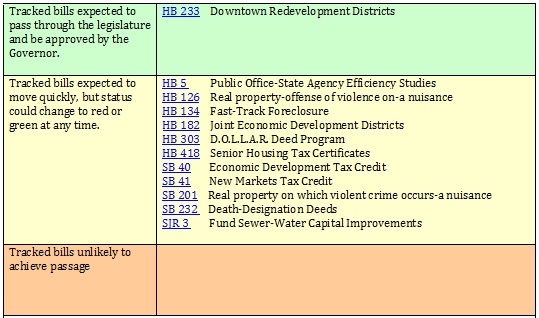
By Lindsey Gardiner, GOPC Manager of Government Affairs The following grid is designed to provide you with insight into the likelihood of passage of the legislation we are monitoring. Please note that due to the fluid nature of the legislative process, the color coding of bills is subject to change at any time. GOPC will be regularly updating the legislative update the last Thursday of every month and when major developments arise. If you have any concerns about a particular bill, please let us know.

Bills Available Online at www.legislature.ohio.gov

Updates on Key Bills:greater-ohio-flag

greater-ohio-flag  HB 182 UPDATE: HB 182 continues to move smoothly through the legislative process. On February 10th, the bill, which proposes to allow local governments to establish Joint Economic Development Districts (JEDDS) for development purposes, unanimously passed out of the House. Since then the bill has been introduced in the Senate and referred to the Senate Ways and Means Committee where it will receive final review. GOPC expects members within the Senate will aptly receive the bill.

greater-ohio-flag  HB 233 UPDATE: Since our last report, HB 233 received its customary third hearing within the Senate Ways and Means Committee. The bill, which proposes to authorize municipal corporations to create downtown redevelopment districts (DRDs) and innovation districts for the purposes of promoting the rehabilitation of historic buildings and encourage economic development, had several witnesses attend committee to offer support earlier this month. Proponents of HB 233 included Chillicothe Mayor Luke Feeney, the Ohio Municipal League, Heritage Ohio, the Springfield Port Authority, and Greater Ohio Policy Center. GOPC suspects HB 233 will receive a fourth and final hearing before being sent to the Senate Floor for third consideration.

greater-ohio-flag  SJR3 UPDATE: Senate Joint Resolution 3, which is one of numerous efforts geared towards addressing Ohio’s “clean water” issue, received its very first hearing on February 10th in the Senate Finance Committee. The bill’s sponsor, Senator Joe Schiavoni (D-Boardman) offered testimony asking the committee to consider his plan to expand sewer and water improvements for municipalities, counties, townships, and other government entities. During the hearing Senator Randy Gardner (R-Bowling Green), who is also Chair of the Lake Erie Caucus, told Senator Schiavoni that he agrees that the state needs to tackle this issue and that SJR3 could be part of the strategy.

New Bills & Explanation of Bill Impact on Economic Development within Ohio:

HB 463 is sponsored by State Representative Johnathan Dever (R-Madeira). This bill proposes to establish expedited actions to foreclose mortgages on vacant residential properties. You may recall our coverage on another bill (HB 134), which offers similar reformative measures to the foreclosure process. HB 463 does indeed amend sections of the Ohio Revised Code akin to HB 134, but there are variances. HB 463 is distinctive in three ways: 1) proposes to allow judgement creditors the right to elect a public selling officer (county sheriff) or a private selling officer to sell the property; 2) orders the state to create and maintain a statewide sheriff’s website where auctions can be managed and conducted; 3) allows a person not in possession of an instrument the right to enforce the instrument if there is proof of entitlement.

Representative Dever’s approach to remedy the issues that exist within the current mortgage foreclosure process pushes the foreclosure process to become more modernized via the creation of an online website. GOPC is continuing to review the potential consequences of the bill, , but we are fully supportive of the principle and overall objective of expediting mortgage foreclosure on vacant and abandoned properties.


For more details and information on legislation that GOPC is tracking, please visit our Previous Legislative Updates.

Memo to Ohio 2016 Political Candidates for Economic Regeneration and Sustainable Prosperity

In an effort to improve outreach to all of Ohio’s 2016 political candidates, Greater Ohio Policy Center (GOPC) has identified key policy areas oriented towards sustainable economic development and revitalization, as well as a general list of policy recommendations that will strengthen our economically competitive communities. This memo is intended to be used as a tool for all of Ohio’s political candidates as they continue through the campaign process. Click here to read the 2016 Candidates Memo

Candidates memo final


The First Step to Revitalization

By Torey Hollingsworth, GOPC Graduate Intern This week, GOPC released a study called the62.4 Reporton urban health and competitiveness in Akron. The report, whose title refers to the city’s square mileage, realistically acknowledges that the city is facing challenges, but also finds that Akron is in a strong position to deal with them. GOPC’s work on small- and medium-sized legacy cities nationwide has found that for many cities, the first step of recovery and revitalization is understanding and accepting their current situation. This may have been more challenging for Akron, because unlike many of its peers, it has not had a clear moment of hitting “rock bottom” when a major economic sector completely left town. Instead, change in Akron has been slower, with a steady stream of residents and businesses leaving the central city for the suburbs and a more gradual shift from a manufacturing-based to service-based economy. Without a major crisis, the alarm bells never rang, even though conditions in the city were declining.

Downtown overhead

Akron, Ohio

Fortunately, many stakeholders in Akron are willing to take a hard look at where Akron is now to plan for where the city can be. Kyle Kutuchief, program director for the John S. and James L. Knight Foundation - which grew out of Akron and funded the study, compares the report to diagnostic testing required when going to the doctor. Once the city knows what is wrong, it can start making a plan for getting better.

Akronites are excited about making that plan. GOPC Executive Director Lavea Brachman and Graduate Intern Torey Hollingsworth travelled to Akron this week to present the report’s findings. At meetings with stakeholders, they had productive conversations about what the city could do to reposition itself as a vibrant, competitive city where people want to live and work. Despite the sobering data, there was clear energy about Akron’s future and resolve to do what it takes to get the city there. Now that the city has taken the tough first step of finding out what needs to change, Akron is even better positioned for recovery. 

Go here to read the report!

GOPC Presents on Complete Streets and Active Transportation Policies

The Greater Ohio Policy Center supports the establishment and implementation of a statewide complete streets policy.  Such a policy, also sometimes called an active transportation policy, means that roadways are sensitive to context and designed for all users. Roads with a complete streets treatment have sidewalks (with curb cuts), bike sharrows or lanes, safe and accessible public transportation stops, and traffic calming designs that keep motorists to the posted speed limit. Currently Ohio does not have a robust statewide complete streets policy, although fifteen local municipalities and four metropolitan planning organizations have passed resolutions or local ordinances in support of complete streets.

For more information, please see GOPC’s recent presentation on the topic:

http://www.slideshare.net/greaterohio/active-transportationcomplete-streets-policies

GOPC Partner Preservation Rightsizing Network Releases Action Agenda

The Greater Ohio Policy Center has been a long time contributor to and supporter of the Preservation Rightsizing Network (PRN).  PRN works in legacy cities to preserve local heritage and revitalize the built environment, bring market sensitive tools and solutions that leverage historic preservation for urban revitalization. GOPC has long supported a holistic approach to legacy city revitalization—calling for a strategic and thoughtful mix of demolition, rehab, historic preservation and new development.  GOPC is pleased to share a video associated with the release of an Action Agenda for historic preservation in Legacy Cities.  GOPC co-sponsored the public event where the report was released and looks forward to supporting Ohio’s communities as they implement tools and policies contained in the Agenda.

Please take 5 minutes to watch this video to learn more about the Action Agenda.

Franklinton Residents Seek to Maximize Impact of Creative District Across Boundaries

By Sheldon Johnson, Urban Revitalization Specialist Last week a panel gathered at the Columbus Metropolitan Club (CMC) to discuss what Columbus Business First reporter Carrie Ghose called “a great urban experiment that is playing before us now.” The experiment she is referring to is the planned redevelopment of Columbus’ oldest neighborhood, Franklinton. The event saw lively discussion from Jim Sweeney, Executive Director of Franklinton Development Association (FDA), Dana Vallangeon, CEO of Lower Lights Christian Health Center, Nick Stanich, Director of Franklinton Gardens, and Trent Smith, Executive Director of the Franklinton Board of Trade (FBOT).

Franklinton was known for many years as an area struck by floods, disinvestment, and high rates of crime. The City of Columbus began a concerted effort towards redeveloping Franklinton in 2011 when then-Mayor Michael B. Coleman announced a partnership between the City of Columbus, the Columbus Metropolitan Housing Authority, a private developer called the Urban Growth Company, and the Franklinton Development Association (FDA) in his annual State of the City Address. Together these four partners sought to “market, incentivize, and build an affordable neighborhood tailored for live-work housing, for our city’s creative sector.” Mayor Coleman defined the creative sector as artists, designers, performers, media professionals, architects, engineers, techies, and marketers. In November 2012 the Columbus City Council adopted the East Franklinton Creative Community District Plan in order to direct the development of this affordable neighborhood for Columbus’ creative sector.

Nearly five years since Mayor Coleman announced his Franklinton plan, the neighborhood has seen the establishment of breweries, the Columbus Idea Foundry, bars, co-working spaces, and coffee shops. During her introduction to the CMC event, Laquore Meadows called Franklinton “the center of cool,” but reminded attendees that Franklinton was home to longtime residents prior to the influx of the creative sector. Can the new dawn of Franklinton be a rising tide to lift all boats? This question was at the forefront of the discussion among the three panelists at the CMC event. In response to a question about what additional investments should come to Franklinton, Stanich pointed out that the strong focus of economic activity pouring into the new creative district located east of State Route 315 was distinct from the largely residential area located west of the highway.

Vallangeon stated that the economic development occurring on the eastside of Franklinton presents an opportunity for more interest and good energy to be carried forward to the west side of the neighborhood. Smith expressed hope that events like the CMC panel will convince potential residents and business that the Real Franklinton is a great neighborhood to be in. Targeting resources in select areas in order to maximize impact is a key revitalization strategy that several Greater Ohio Policy Center partners are currently undertaking. The creation of intentional revitalization plans is key to the regeneration of many of Ohio’s urban areas.

GOPC Legislative Update January 2016

By Lindsey Gardiner, GOPC Manager of Government Affairs The following grid is designed to provide you with insight into the likelihood of passage of the legislation we are monitoring. Please note that due to the fluid nature of the legislative process, the color coding of bills is subject to change at any time. GOPC will be regularly updating the legislative update the last Thursday of every month and when major developments arise. If you have any concerns about a particular bill, please let us know.

January Leg. Update Grid


Updates on Key Bills: greater-ohio-flag

greater-ohio-flag HB 303 UPDATE: HB 303 continues to move smoothly through the legislative process and was referred to the Senate Financial Institutions Committee on January 20th. With the Ohio Housing Finance Agency’s support of HB 303, GOPC is optimistic members within the Senate will aptly receive the bill. GOPC offered Interested Party testimony on behalf of HB 303 and plans to continue offering support as it proceeds through committee within the Senate.

greater-ohio-flag HB 340 UPDATE: GOPC is happy to report that HB 340 was signed into law on December 22nd, just 9 days before the Local Government Innovation Council (LGIC) was set to expire. As we reported in December, HB 340 contained more than an emergency extension of the LGIC as it soon became known as a budgetary corrections bill as well. GOPC commends the Legislature for coming together to extend the LGIC, which has provided loans and grants for local government innovation projects to hundreds of communities across the state.

 greater-ohio-flag HB 233 UPDATE: HB 233 continues to move through the legislature as it was scheduled for a second hearing in the Senate Ways and Means Committee. Five witnesses testified as proponents to the bill, which included Youngstown State University President Jim Tressel; Shaker Heights Mayor Earl Leiken, the Canton Regional Chamber of Commerce, and the COO of the City of Toledo Eileen Granata. GOPC has offered interested party testimony for HB 233 while it was being vetted by the House, and we look forward to offering interested party testimony in a future hearing.

 greater-ohio-flag SB 232 UPDATE: Earlier this week, the Senate Government Oversight and Reform Committee heard proponent testimony for SB 232. The Ohio State Bar Association was the only organization that offered testimony in support of the bill. Currently, there is no legal protection between ex-spouses for real estate that passes by way of a transfer-on-death (TOD) affidavit or deed. SB 232 intends to bring TOD affidavits and deeds for real estate in line with other areas of the Revised Code. GOPC commends Senator Kevin Bacon (R-Franklin) for championing this corrective legislation and plans to offer support of the bill that will help establish consistency with respect to the legal effects of divorce, dissolution, and annulment on beneficiary designations.


New Bills & Explanation of Bill Impact on Economic Development within Ohio:

HB 418 is sponsored by State Representative John Barnes (D-Cleveland). This bill proposes to enact the “Senior Housing Relief Act”, which will prohibit the sale of delinquent property tax certificates for homesteads owned for at least 20 years by a person aged 65 or older. Currently, local governments can place a lien on a property that is delinquent in property tax payments. HB 418 would remove properties that fall under the Senior Housing Relief Act from the list of parcels that may be selected for a tax certificate sale. HB 418 seeks to address an increasingly serious issue many Ohioans within the elderly community face. This bill will provide a much-needed supportive service to communities and will have positive long-term effects as it will keep people in their homes thus preventing blight.


For more details and information on legislation that GOPC is tracking, please visit our Previous Legislative Updates.