
2026 Ohio Transportation Engineering Conference Presentation
Greater Ohio Policy Center (GOPC) was pleased to have been selected to present two sessions at the 2026 Ohio Transportation Engineering Conference (OTEC) in Columbus on October 20-21, 2026.
Below is one of two presentations which GOPC shared, Downtowns & Parking: How to Engage the Business Community About AT Investment.
This presentation was modeled after a panel facilitated by GOPC at the 2026 Ohio Active Transportation Conference. Thank you to our presenters Chris Hermann, Betsy Pandora, and Jodie Perry for their presentations which served as a foundation for GOPC’s presentation at the conference.
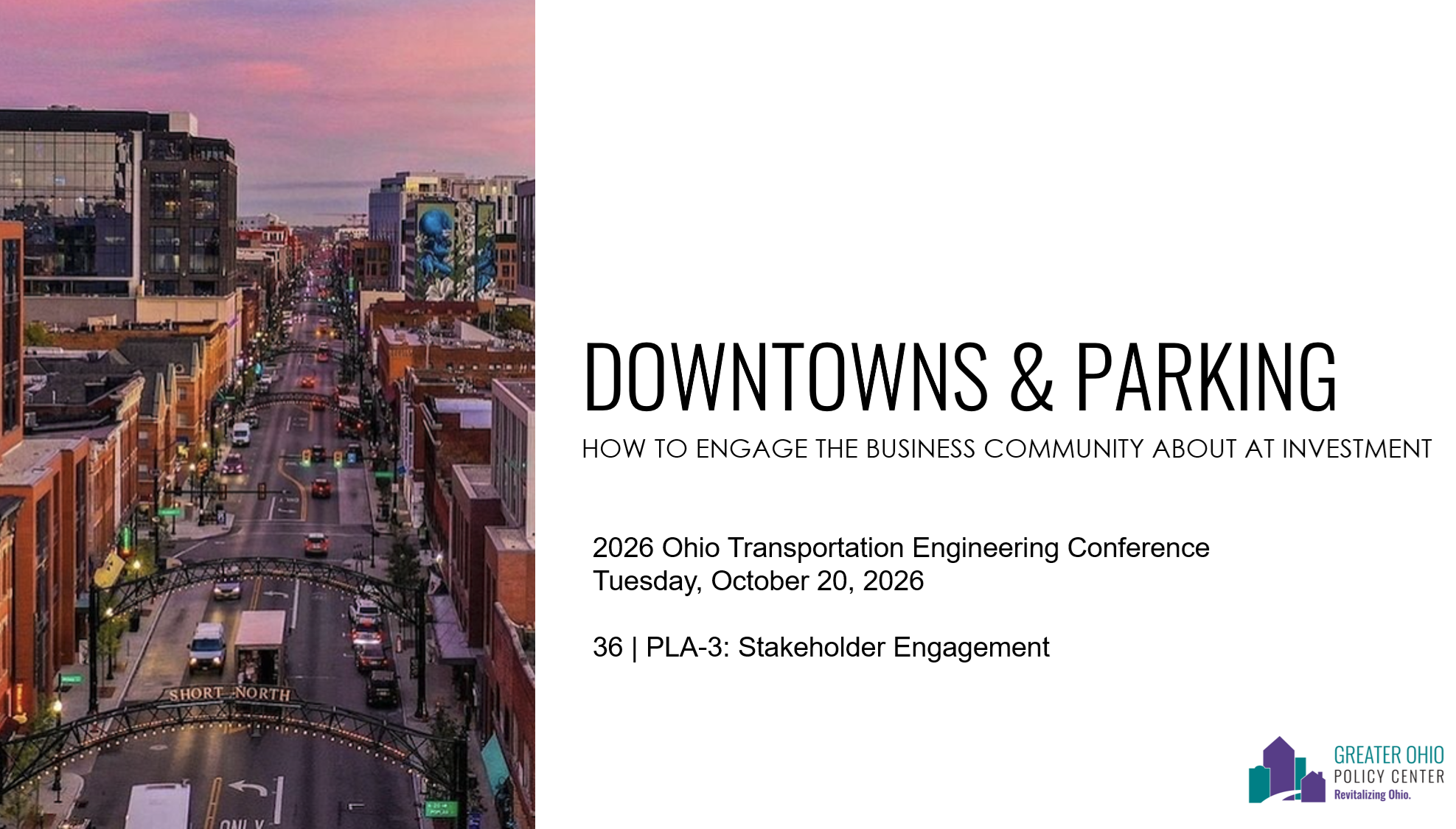
Click the image to access a PDF of the PowerPoint presentation. Presentation transcript is available below.
Slide 1
Good afternoon and thank you for joining me today. Hopefully you are all here for the correct session, this is Downtowns & Parking: How to Engage the Business Community About AT Investment.
My name is Jason Warner, and I am presenting this session on Stakeholder engagement.
Slide 2
Before we begin, a bit about my organization, the Greater Ohio Policy Center, or GOPC. We are a statewide, nonpartisan public policy organization that advances strong local economic and community revitalization across Ohio by equipping communities and leaders with place-based research, collaboration, and advocacy, all with the aim of fulling our Vision of a Revitalized Ohio.
We work with groups across the state by providing mission-based research, and work with communities by providing fee-for-service consulting. We also steward a number of peer leading groups that are mission focused, and we advocate at the statehouse and with state agencies for policies and programs that support revitalization and community vibrancy.
Slide 3
Much of that work involved transportation.
Transportation is one of the 4 pillars of our policy work, and we advocate for a mobility network that is safe and reliable for all users – thus our passion for active transportation.
AT touches every Ohioans, from students who walk to school, the commuter who bikes to the office, and of course for anyone who runs or rolls for recreation.
Every single person in this room benefits from a safe and accessible transportation system.
That is why GOPC in the past several years has worked to publish two active transportation planning and development guides which help to educate communities on ways to implement an AT project, funding sources, and technical assistance programs at the state and federal level that can help plan and fund projects.
We also publish the Ohio Active Transportation Newsletter, which seeks to educate advocates and the public at large about opportunities to invest in more active transportation infrastructure statewide.
And just last month, GOPC played host to the second Ohio Active Transportation Conference, bringing together more than 200 planners, engineers, local government leaders, and advocates to learn, network, and gain the tools they need to build safer streets and vibrant communities in Ohio.
That event was such a success that we are already in the preliminary planning stages to host another conference in September of next year!
Advocating for these policies however has led us to also be keenly aware of what of the greatest challenges investment in active transportation suffers from – and that is challenging the status quo.
And that’s what brings me to this session today.
Slide 4
One of the biggest obstacles communities can face when proposing new active transportation projects is pushback from businesses worried that their sales will suffer if parking is moved or removed.
Instead of fighting with business owners who are concerned with their livelihood, what can planners and advocates do to win the support of these important community members?
Today, I will focus on what cities can do to earn that support: bring businesses into the design early, resolve access problems, manage construction carefully, and demonstrate that concerns lead to action.
We are going to focus on how to engage with the business community when an active transportation project or plan is on the drawing board, addressing the needs, wants, and desires of everyone who seeks vibrant spaces that can accommodate all mode users.
Slide 5
Even a temporary disruption can have long-term negative consequences for small businesses that rely on foot traffic and customers traveling to a destination area like a central business district.
When a city proposes a bike lane, a wider sidewalk, or a safer crossing, a business owner may hear something very different from what the city intends.
The city sees a safer street. The owner sees fewer parking spaces, a delivery truck with nowhere to stop, or months of construction outside the front door.
Those concerns deserve specific answers. Owners have payroll to meet and customers to retain.
A project that looks attractive five years from now still has to work for a business next Tuesday.
How can early opposition to a proposal – or mid-work frustrations – be overcome?
Slide 6
All things in life require collaboration.
When we are talking about an active transportation project in a busy downtown or central business district, collaboration with the business community is a must.
You should plan to meet early and meet often with interested parties throughout all the stages of a development project.
Working on an active transportation project in more ways than one is a phased process.
Yes, there is phased work in terms of construction – but there are also multiple stages that must be accomplished before and during the process.
Our engagement discussion will focus on these three stages
The Idea Stage
The Planning Stage, and the
Construction Stage
Slide 7
In the Idea Stage – we know that there is a problem, and we are working out a solution.
For an active transportation project, the city knows that there are more and more folks in the community who are riding bikes to get around – city leaders see it with their own eyes, and first responders are reporting that there are upticks in accidents and, tragically, even a death resulting from unsafe roadways in and around downtown.
Leaders are talking about installing a bike lane, wider sidewalks and enhanced crosswalks to help make residents feel safer when shopping, dining, or conducting business downtown.
You have your idea – now what do you do?
Charge ahead or proceed through our list of collaboration ideas?
Yes, you want to collaborate. How can we do this?
It’s always good to begin by soliciting input.
Engage with as many groups as you can. Business owners, neighborhood groups, residents, and the community at large about what changes they want to see. You can do this a number of ways –
Send out surveys,
Create focus groups,
Host pop-up shops or events that allow the community to be engaged.
It’s also good to have a conceptual plan in place to help give the community an idea of what is possible.
When someone hears “we are taking away 5 parking spaces” people will panic. When they see what the plan is to replace it, opinions can be changed or swayed.
And the media can be your friend here too.
Engaging the press early and often is key keeping an idea top of mind and helps to build excitement. You know that opponents will be running to the media to complain… early engagement can help to steer the conversation.
Let's look at Mansfield Ohio as an example. GOPC covered Mansfield’s Main Street Corridor Improvement project in our first AT Development Guide in 2024, and hosted their Mayor, Jodi Perry, at our AT Conference last month to discuss this project.
Slide 8
In 2019, a group of emerging leaders issued the 2019 Mansfield Rising Downtown Investment Plan.
Out of that grew the Mansfield’s Main Street Corridor Improvement Plan, a multiyear economic development campaign to make the Main Street corridor more welcoming and pedestrian friendly.
The plan focused on three core principles:
Mansfield is a place for business,
Mansfield is a place for gathering, and
Mansfield is a place for living.
At its heart was a plan to improve the walkability of the downtown core of the city, and the radiating impact this would have on improvements to the whole of the city.
That plan won support from the Richland Community Foundation, which began to work with the City of Mansfield to develop an actionable plan to improve the downtown corridor.
That was approved in 2021.
During the intervening two years, the group, working with the city, sought feedback on the plan from focus groups and surveys.
The business community was engaged from the beginning of the process due to the participation of representatives from the local Chamber of Commerce in the initial planning work – even before the city was involved.
Slide 9
Once there is agreement on the need for work, the planning can begin.
There are lots of aspects to the Planning Stage.
You have an idea and people support the idea. You even have some nice pretty drawings – but it is still more a concept that an actual plan.
You still need to be engaged with stakeholders.
Business opposition often becomes sharper when those choices arrive as a finished drawing. The owner feels the city has already decided on a course of action and who will bear the cost.
The good news is that you can still listen to those concerns and, where appropriate, incorporate changes.
Show plans and alternatives early enough that the tradeoffs can still be discussed.
Suppose a merchant says, “This bike lane will kill my business.” We should take the concern seriously and ask what the owner expects to happen.
Will customers lose a convenient place to stop?
Will deliveries cross the bikeway?
Will the storefront become harder to see?
Each answer points toward a different design response.
A loading concern may call for a designated loading area near the entrance, with enough room and appropriate hours. A concern about customers carrying large purchases may call for a short pickup space. A concern about older customers may call for a closer accessible arrival point and a safer route to the door.
Offer several ways to meet the need. Compare their effects on street safety and business operations. Walk the alternatives with the owner, the designer, and the staff responsible for managing the curb. A small adjustment on a drawing can make a large difference when someone has to move merchandise through that space every day.
Some requests will conflict with the project’s safety goals. Be honest about that. Preserving a hazardous crossing or requiring cyclists to merge into fast traffic may defeat the purpose of the investment. The city should explain that limit and work toward another way to provide access.
Owners do not need every preference accepted to believe the process is fair. They need to see that staff understand their operations, explain the tradeoffs, and make reasonable changes where the design allows them.
Slide 10
An example of disruption during the planning stage is what happened in Columbus in 2021.
As part of a routine street resurfacing plan on Indianola Avenue in the city’s Clintonville Neighborhood, the city resurrected plans from the citywide active transportation plan that had been written nearly a decade before to add a bike lane in both directions of the street – including through a commercial corridor on the street.
The plan would have resulted in the removal of multiple on-street parking spaces through the corridor.
That plan was quickly met with strong opposition from the business owners along that corridor – including a small locally-owned movie theater. Business owners were concerned that the removal of on-street parking would hurt their businesses because customers would be moved to adjoining residential streets, causing further problems.
This touched off a nearly six-month war of words in the press and online messaging boards with bike advocates, residents, and business owners all arguing over what the right approach was, with the city somewhat stuck in the middle – recognizing that there was a need for work to be done, but how to work out the appropriate compromise.
Could this have been avoided had the city engaged in outreach with business owners ahead of time? It’s hard to say. This was part of a pre-existing plan. It was nearly 10 years old at the time the work was announced. Perhaps previous business owners had been consulted – but shops close, owners change. Businesses experience growth.
A lot can happen in 10 years.
An accommodation was ultimately reached, and the resulting resurfacing project was completed this summer, with parking spaces preserved immediately adjacent to the business strip, bike lanes added in both directions, and traffic lanes preserved.
This project is near our office and having watched the process from start to finish – including living through the war of words – I can say the result is exactly what you are looking for in a situation like this.
No one got everything that they wanted – but the end result gives everyone something that was needed.
But we’ve jumped ahead just a bit.
Slide 11
This is also the stage where you can work with both the business owners and the construction company to find as many ways as possible to minimize impact.
Ask what must happen for each affected block to remain usable. How will customers reach entrances? Where will deliveries unload? How much advance notice will businesses receive before access changes? Who will restore a temporary walkway if it becomes blocked or damaged?
Discuss business calendars before settling the work sequence. A holiday sales period, festival, or seasonal peak may warrant an adjustment where feasible.
If you are working on a project in Sandusky, maybe try to avoid work in the summer when you know tourists will be plentiful in the area due to your proximity to Cedar Point
That can’t always be avoided – but again, try to find ways to minimize disruptions
Are there better times of day to do the work that won’t disrupt business during the day
Night work might help one business while creating problems for nearby residents or another business. Evaluate the tradeoff before committing to it.
Then explain the plan in ordinary language. Owners should know what happens first, which entrances remain available, and whom to contact if actual conditions differ from the plan.
The city earns confidence when it can say, “These accommodations are part of how we have directed the contractor to perform the work.” Construction access should have an owner, an inspection process, and resources behind it.
Importantly, you want to make sure all of this is down in writing. Business owners may be able to live with the finished design and still fear the construction stage. That concern deserves attention before the city awards the contract.
Include business accommodation and accessible pathways in construction bid documents. Specify the access arrangements and the process for approving closures. Set expectations for notice, temporary signage, and maintaining routes to occupied storefronts. Identify who inspects those arrangements and who can require a correction. Plan for weather and utility surprises, because the schedule will sometimes change.
That matters because a verbal assurance at a public meeting is difficult to manage once crews are working. Contract requirements give the city a basis for directing the work and addressing failures.
Slide 12
So, we had an idea – that idea has now advanced and we have a concrete plan on what we are going to do – we know how it’s going to get paid for, and we even have the team lined-up to do the work.
That was the easy part.
Now we are entering the Construction Stage and with it, the disruptions.
We call it the Construction Stage, but it could just as easily be called the Challenges Stage.
This is when what looks good on paper and sounds good in theory gets tested by the actual physical work of ripping up streets, maybe needing to relocate sewar lines or communications cables. Sidewalks are blocked off and, in some instances, ripped out.
Things get messy.
Especially for businesses. This is when their concerns become real. Perhaps the two-way street becomes a one-way street so traffic can at least still move through. Put parking spaces are gone. Where does the delivery truck go? You have temporary parking available but that is limited. People hear about the construction and change plans – they don’t want to deal with the hassle.
Business owners are feeling a mix of emotions.
They feel vindicated – see, I told you this would happen.
But they are also worried – what’s this doing to my bottom line. I have payroll and expenses to meet. Things are getting tight. Are we going to have to close?
This is when having a good plan in place – and a full availability of resources – can be helpful.
First, it’s good to have a prearranged communications plan which has channels of communication both for the public and for business owners. Have talking points ready when those phone calls start coming in.
Have people in the city and if possible, at the community level, who can speak about the project and communicate with stakeholders. Work with the chamber of commerce or downtown association to have resources available that can assist.
Keeping the vision alive is key. Having signs and posters that show what the end result will be helps to maintain enthusiasm for the project, even through the disruptions.
Leaders need to make themselves available too – not holed-up or hidden.
In Mansfield, Mayor Perry walked the construction area regularly, frequenting the impacted businesses, taking with owners, and sharing their stories on social media to help show support for the business community and maintain enthusiasm for the project.
But sometimes deeds are not enough. You need to have a plan to offer additional support to help keep businesses afloat.
Slide 13
In Mansfield, the city provided Business resilience grants of $2,500 to support small businesses impacted by the construction.
The current Capital Line project, with support from the city, is proving grants ranging from $6,300 to $12,500 to assist with needs such as rent.
They also recently announced, through a combined effort of the quasi-public downtown development agency Downtown Columbus, Inc. and the tourism organization Experience Columbus, a new Downtown Discovery Pass.
This is a free program that rewards residents and visitors who patronize Gay Street businesses with gift cards, artwork, and a tote bag.
Anyone who checks in at least once is also entered into a random drawing for a $50 gift card to a participating Gay Street business.
Slide 14
Another example is what happened in the Short North – just outside the conference center here, just a few years ago.
During a major, multi-phase, multi-year construction campaign which saw sidewalks widened and streetscapes enhanced, the local business nonprofit the Short North Alliance, worked in several ways to support businesses throughout the construction process.
This included
providing free first-hour parking in area parking garages for customers,
working with the city to place art on construction barricades to beautify the construction area – as shown here in this photo,
arranging a partnership with Columbus State University to enable businesses to access financial and business improvement counseling free of charge to support their business planning during streetscape construction, and
partnering with Huntington Bank to create a low-interest revolving line of credit for businesses with a two-year deferment period for payback. This allowed businesses to access up to $200,000 in capital to support their business needs during construction, with 5-year repayment timelines.
So, what can we draw from all of this.
In the end, our main takeaway is
Slide 15
This work is a short-term pain which often leads to long-term gains.
Slide 16
Whenever one starts talking about deviating away from the status quo, opposition is not only likely, it’s inevitable.
The examples we have highlighted in today’s presentation provide a clear place to begin.
Collaboration is always better than confrontation, and compromise and accommodation are necessary for any project to be a success.
Involve business owners early, while the project can still change. Show how customers, workers, and deliveries will reach the businesses.
Put construction accommodations into the work requirements and arrange assistance before disruption begins.
Slide 17
Then maintain a direct relationship with the people affected. Give them useful updates, act on access problems, and return to check how the completed street works.
As an example, both the Mansfield and Capital Line projects have dedicated websites that provide real time updates about construction, disruption, and ways that businesses can be supported during the work.
Cities should ask for business support when they can point to specific commitments and show how business input improved the plan.
That gives owners something concrete to support.
And where possible, provide relief. From business counseling to freebees for customers, and even financial arrangements to help keep businesses afloat, accommodation and support will help to move the project along and ensure the project is a win-win for everyone involved.
Slide 18
Our goal should be to create a commercial district where safer walking and biking fit alongside the needs of operating businesses.
The strongest case comes from a project that helps people reach those businesses and gives owners confidence that the city will follow through.
Slide 19
So, with that, I will open the floor to any questions anyone might have.
Slide 20
Thank you, that’s all the time we have today. Please feel free to come and speak with me after the session today, or if you would like, here is my contact information so that we can connect away from the conference.
Thank you again for joining us today and please enjoy the rest of the conference.