
2026 Ohio Transportation Engineering Conference Presentation
Greater Ohio Policy Center (GOPC) was pleased to have been selected to present two sessions at the 2026 Ohio Transportation Engineering Conference (OTEC) in Columbus on October 20-21, 2026.
Below is one of two presentations which GOPC shared, Adapting 20th Century Standards to Fit the Modern World: How E-Devices Create a need to Update Design Standards & Policy.
This presentation was modeled after a panel facilitated by GOPC at the 2026 Ohio Active Transportation Conference. Thank you to our presenters Matt Lindsay, Steve Magas, and Jean-Ellen Willis for their presentations which served as a foundation for GOPC’s presentation at the conference.
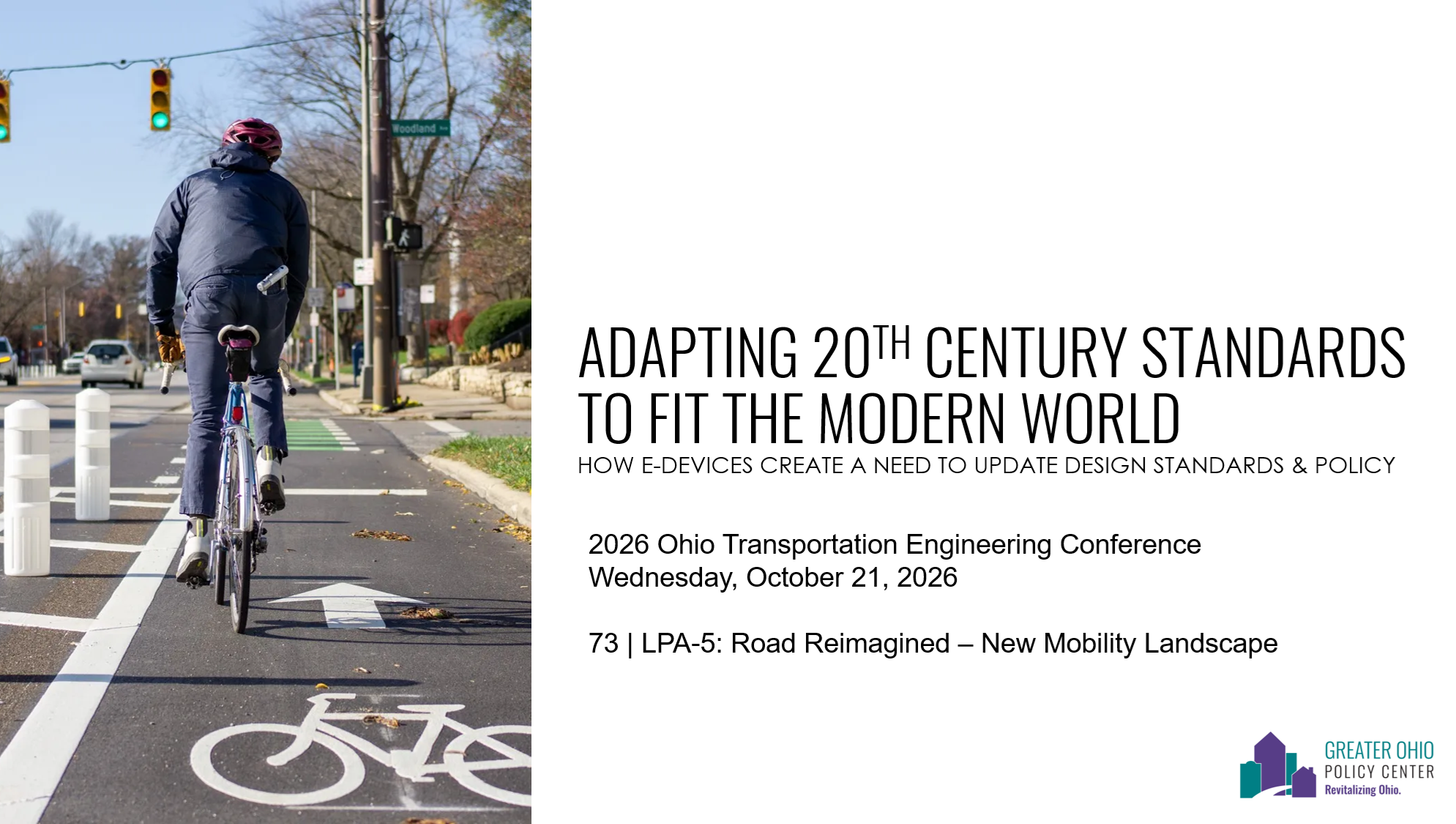
Click the image to access a PDF of the PowerPoint presentation. Presentation transcript is available below.
Slide 1
Good afternoon and thank you for joining me today. Hopefully you are all here for the correct session, this is Adapting 20th Century Standards to Fit the Modern World. How e-devices create a need to update design standards and policy.
My name is Jason Warner, and I am presenting this session on roadway redesign and the mobility landscape.
Slide 2
Before we begin, a bit about my organization, the Greater Ohio Policy Center, or GOPC. We are a statewide, nonpartisan public policy organization that advances strong local economic and community revitalization across Ohio by equipping communities and leaders with place-based research, collaboration, and advocacy, all with the aim of fulling our Vision of a Revitalized Ohio.
We work with groups across the state by providing mission-based research, and work with communities by providing fee-for-service consulting. We also steward a number of peer leading groups that are mission focused, and we advocate at the statehouse and with state agencies for policies and programs that support revitalization and community vibrancy.
Slide 3
Much of that work involved transportation.
Transportation is one of the 4 pillars of our policy work, and we advocate for a mobility network that is safe and reliable for all users – thus our passion for active transportation.
AT touches every Ohioans, from students who walk to school, the commuter who bikes to the office, and of course for anyone who runs or rolls for recreation.
Every single person in this room benefits from a safe and accessible transportation system.
That is why GOPC in the past several years has worked to publish two active transportation planning and development guides which help to educate communities on ways to implement an AT project, funding sources, and technical assistance programs at the state and federal level that can help plan and fund projects.
We also publish the Ohio Active Transportation Newsletter, which seeks to educate advocates and the public at large about opportunities to invest in more active transportation infrastructure statewide.
And just last month, GOPC played host to the second Ohio Active Transportation Conference, bringing together more than 200 planners, engineers, local government leaders, and advocates to learn, network, and gain the tools they need to build safer streets and vibrant communities in Ohio.
That event was such a success that we are already in the preliminary planning stages to host another conference in September of next year!
Advocating for these policies however has led us to also be keenly aware of what of the greatest challenges investment in active transportation suffers from – and that is challenging the status quo.
And that’s what brings me to this session today.
Slide 4
E-bike use has grown rapidly across the United States and in Ohio, and the market is expected grow by another 15% in the next 5 years.
This growth represents a major opportunity to reduce car dependency, as research shows e-bikes are replacing vehicle trips for everyday travel.
At the same time, communities are experiencing a rise in crashes involving e-bikes, particularly among younger riders. Although Ohio does not track e-bike crash data, local reports suggest safety concerns are increasing.
Today, we are going to explore how planners, engineers, and policymakers can support the continued growth of e-mobility while improving safety through updated roadway design standards, modern infrastructure, and local and state policies that better accommodate e-bikes and other emerging transportation technologies.
Slide 5
So, before we can go any further – what is it that we mean when we talk about e-devices.
Since 2021, Ohio has set a definition for what constitutes an electronic bicycle.
ORC Sec. 4511.522 defines e-bikes, establishes standards for labeling the devices, and specifies where certain devices can be used, among other things.
Class 1 bikes are defined as pedal-assist only devices that do not include a throttle. They have a max speed of 20mph.
Class 2 bikes are defined as devices with both pedal assist and a throttle. They have a max speed of 20mph.
Class 3 bikes are defined as pedal assist devices that do not, but may include, a throttle. They have a max speed of 28 mph. The ORC requires Class 3 devices to be equipped with a speedometer that displays the speed of the electric bicycle in miles per hour.
Class 1 and Class 2 bikes are permitted on a path set aside exclusively for use of bicycles or on a shared use path, unless the county, township, municipal corporation, or other local authority or state agency has prohibited their use in such places.
Class 3 devices are not permitted on bike or shared-use paths unless the path is adjacent to a highway or the county, township, municipal corporation, or local authority or state agency with control over the path has authorized their use.
No e-device can be operated on a path that is reserved for non-motorized use unless authorized by the county, township, municipal corporation, or local authority or state agency with control over the path.
Law enforcement is exempt from these regulations if use of e-bikes has been authorized.
While a license is not required to operate any e-device, anyone under the age of 16 may operate a Class 3 e-device. Those under 16 may ride as a passenger on a Class 3 device designed to accommodate passengers.
Finally, no one is authorized to operate or be a passenger on a Class 3 device unless they are wearing a protective helmet.
Those are the classes, but what fits those definitions.
Slide 6
E-bikes generally fall within the Class 1 definition.
Most e-Scooters such as those you see outside the convention center here which you can rent, or that you can purchase in store fall within the Class 2 definition.
This also includes e-Skateboards, including those large, single-wheeled boards you occasionally see out and about.
Class 3 devices include seated e-Scooters, a sort of hybrid e-bike/e-scooter which may include a basket for carrying bags or packages, or Hoverboards – well what passes for a Hoverboard, not the once we were promised when I was a kid - fall into this category.
So when we are talking about e-Bikes, we mean a device that should have a pedal-assistance device – not a full- on board motor, and not something that includes a throttle. The motor should be at or below 750 watts and have a max speed of 20 miles per hour.
Slide 7
What is not an e-bike is what is sometimes called an e-moto, short for electric motorcycle. Basically, a lightweight electric powered dirt bike. E-moto’s are classified as a motor vehicle rather than a bike due to the amount of power it has as well as a lack of fully operable pedals.
E-bikes have a maximum of 750 watts of power. E-motos can range from anywhere between 1,000 to 15,000 watts of peak power.
E-bikes have a speed range of 20 mph – though some can reach the class 3 speed of 28 mph. E-motos are capable of reaching speeds from between 30-60 mph.
E-bikes must feature fully functioning, operable pedals. E-motos typically lack pedals, instead relying on foot pegs.
E-motos are not bikes. They must be registered with the Bureau of Motor Vehicles (BMV), equipped with standard motor vehicle safety features (lights, mirrors, turn signals), and operators must hold a valid driver's license or motorcycle endorsement along with insurance. Because they are classified as motorized or off-road vehicles, e-motos are strictly prohibited on non-motorized bike paths, shared-use trails, and mountain biking tracks.
Part of the problem many communities are dealing with today is that people are using equipment they think is an e-bike but is not. The proliferation of third-party sellers on sites like Amazon and Temu have resulted in parents purchasing what looks like – or is advertised as an e-bike but functionally is closer to an e-moto device.
Slide 8
While putting this presentation together, I went to Temu to demonstrate this point. As you see, I searched for e-bikes. At least 2 of the devices that it pulled up under this search are clearly e-moto devices.
Slide 9
But a parent may not know the distinction. They intentionally searched for an e-bike, and this is what came-up as part of the search. So what is it that we can do to ensure that the devices we are trying to regulate and build around are what is on the roadway?
Slide 10
The use of electric bicycles, or e-bikes, has grown rapidly in recent years, and Ohio is no exception. Nationally, sales of e-bikes have skyrocketed, rising from 250,000 units sold in 2018 to over 1.1 million in 2022. This is an incredibly positive trend as academic research shows that e-bikes are shifting people out of vehicles for everyday needs.
How electric bikes reduce car use: A dual-mode ownership perspective, a 2024 study published in Transportation Research found that
E-bikes can lead up to a 19% reduction in car mode share in dual-mode households.
Increased car choice begins at 5 and 1.5 km for dual-vehicle and car-only owners.
E-bikes encourage a greater variety of non-commuting activities for car-owners.
E-bikes facilitate commuting, while also enhancing travel autonomy for the elderly.
However, with that increase in usage, there has also been a surge in crashes involving e-bikes, with younger Ohioans being the most vulnerable in these crashes. While crashes involving e-bikes are not tracked separately from other crashes involving standard bikes, there is plenty of anecdotal evidence from around Ohio to support this.
Slide 11
In August of last year, the Dayton Daily News reported that Dayton Children’s Hospital had reported an 80% increase in the number of children being treated due to e-bike and e-scooter incidents.
Last month, the Cleveland Plain Dealer ran a story reporting that local hospitals are seeking an increase in riders suffering injuries ranging from cuts and scrapes to broken bones and brain trauma.
The Cleveland Clinic reported that most injuries were suffered by boys between the ages of 10 to 16.
MetroHealth Systems reported 43 e-bike related injuries over the summer, an increase of nearly 50% from the year before.
In Mid-July, Akron Children’s Hospital said that it had surpassed the number of e-bike and e-scooter injuries than it saw in all of 2025. Akron Children’s said injuries included brain injuries, extremity fractures, road raash, lung contusions and abdominal injuries.
Rainbow Babies estimated that it treated nearly 30 e-bike injuries, suffered by youth ages 9 to 16, in June, July and August combined.
“Year-over-year data shows a steady increase in these injuries, and we anticipate 2026 will have the highest number of e-bike injury cases on record,” according to Dr. Al Reem Al Hinai, the pediatric trauma medical director at Rainbow Babies.
Slide 12
These reports echo national trends. In 2025, the American College of Surgeons issued a Statement on E-bike Safety and Injury Prevention. In that statement, they reported use of e-bikes as being associated with a growing number of series injuries – particularly among children and adolescents. The reported over 20,000 people are injured while riding electric bicycles annually with approximately 3,000 individuals requiring hospitalization, and this is likely underreported.
The report said that injuries are increasing annually, and the severity of injuries is greater than manual bike counterparts.
Finally, they found that head injuries are occurring most frequently, and only a third of injured patients are reported to wear helmets.
These are indeed sobering numbers, and should give all of us pause. Clearly, there is an e-bike problem. So, what are we to do.
Some have talked about banning e-bikes. But that would be like throwing the baby out with bath water. When automobiles were first replacing horse and buggy – accidents were certainly greater and the severity far worse than what would occur in those crashes – but they were not outlawed. Laws were updated and infrastructure modernized to meet the evolving demands of the new infrastructure.
Slide 13
What was true in the 20th Century – updating the rule book from the 19th Century, is just as true today. We need to work to update our 20th Century rule book, and 20th Century Infrastructure, to meet the needs and demands of the 21st Century.
Essentially, we need to re-think transportation infrastructure.
A good part of the reason why we are seeing such a surge in crashes involving e-bikes and other e-devices is because of the location they are being ridden. Most of the user under the age of 16, are using these devices on sidewalks – the places most kids ride bikes. The technology has evolved but the behavior has not.
Slide 14
Lots of us probably grew up on or now live on streets that look like this one in Lakewood. It has wide sidewalks that intersect with driveways every 30-50 feet or so. There are probably cars parked on the street.
Parents know cars travel down the street pretty frequently, so they tell the kids to stay out of the street when they are outside playing.
Even in my childhood, there was risk to riding my bike on the sidewalk with cars pulling in and out of driveways or crossing an intersection with a car driver that may or may not be paying proper attention. And that was when the bike was traveling at, say 5mph just peddling.
Now imaging that bike is traveling down the sidewalk at 20 mph… the same speed you are supposed to be driving down the street in a school zone.
That equipment should not be on the sidewalk.
But Ohio law leaves the regulation of whether bikes are permitted on sidewalks up to local communities. And parents are doing what they think it keeping their kids safe.
The technology has changed – but the behavior has remained the same.
We can update laws and many communities are.
Slide 15
Dozens of communities throughout the state have been working to update rules and regulations around e-bikes over the last year or so in the face of rising crashes. Many of these local ordinances hold parents legally and financially responsible if their child violates local or state e-bike regulations or causes a crash.
Just two weeks ago, a bill was introduced in the Ohio Senate, Senate Bill 477, which seeks to eliminate this patchwork approach and instead create a uniform state safety standard for how e-bikes, low-speed micromobility devices, and electronic personal mobility devices are operated.
The proposal would require riders to wear helmets and prohibit anyone under 14 from operating these devices. Riders under 18 would also be barred from using high-powered e-bikes.
The legislation would set a 10-mile-per-hour limit on shared-use paths and a 5-mile-per-hour limit on sidewalks.
There is well-meaning intent with these types of responses, and in some cases they will indeed help. But they are not foolproof.
Slide 16
Regulations on speed of equipment or age limits on riders require enforcement.
Law enforcement – particularly in cities, are already forced to prioritize enforcement due to limited staff and resources. Anyone who has spent time here in Columbus knows how closely the existing ban on e-Scooters on sidewalks is enforced. Law enforcement is unlikely to start stopping riders to see if they are old enough to operate an e-Bike and are likely only going to become involved after the fact.
The same can be said about where they are used. Police tracking down an e-bike user on a shared use path or sidewalk is unlikely as there are other offenses that will inevitably be prioritized.
Cities have tried to limit where certain devices can be used. Again, not to pick on the e-Scooters but Columbus tried to restrict where can be used, insisting on technology being impeded in the devices that would cause the devices to lock-up and become inoperable in certain public spaces like trails and parks. However, that technology only works on rentable, shared-use devices and does not limit where someone can operate a privately owned device.
That points to the second problem which exists with these plans – and that is the ability to hack the technology.
Even when laws exist and manufacturers seek to limit how fast e-Bikes and other e-Mobility devices can travel, simple bypasses and equipment hacks exist which can overcome these limits. A simple Google search in preparing this presentation found dozens of videos on YouTube and other platforms which offer tips and tricks on how to override limits and enable users to make their equipment travel faster.
If you don’t think kids can access this, you’re wrong.
I don’t mean to disparage efforts to enact these regulations. They should indeed be undertaken.
But let’s again go back to the question about what we did when transitioning from buggy to automobile. We updated the rules and regulations, but we also updated the infrastructure.
Slide 17
Admittedly, updating infrastructure as not something that happened overnight. It took decades for our transportation infrastructure to evolve into what it is today. These photos are intended to show that evolution.
At the left is a photo of East Broad Street here in Columbus from roughly 1890. You see sidewalks and dirt roads – maybe some brick pavers – it’s hard to tell from the photograph. The streets are wide, but they are filled with horses and buggies. There are no lanes marked in the street, so signage – and no crosswalks. The traffic moved slow. People were able to cross where they needed to.
On the right is another photo of East Broad Street in Columbus taken in 2025 and copied from Google Maps. There are sidewalks and asphalt roadways. There are lanes marked. In this particular photo – there are seven lanes that move traffic in and out of downtown. Hanging overhead you see signs that indicate clear lanes for turning onto upcoming roadways. There are traffic lights visible in the distance. Though not shown in this photo – roadways today do have marked crosswalks – sometimes will signals saying when it is safe to cross. Increasingly, we are seeing heavier volume streets – and usually streets that have high rates of collisions – with flashing beacons to indicate when a pedestrian is crossing.
The street is the same – it technically serves the same purpose. But it has evolved – it has been updated and modernized to meet the needs of modern mobility.
What else does the photo show?
I mentioned it once when describing the street in 1890.
Yes – it’s wide. In fact, If you were to compare the street in 1890 and compare the street today, you would likely find that it is the same width. That has not changed. It was a wide boulevard then and it is a wide boulevard now. I understand in some stretches of the road 100+ years ago there were treelined center medians that don’t exist today – removed to accommodate more travel lanes – but the point is that the existing roadway was reconfigured to suite the needs of the transportation technology that was evolving.
At one point in the 20th Century this same roadway would have also accommodated streetcars. Those were removed starting in the late 1940s and early 1950s and cars became more and more accessible to middle class families.
Again – the roadway evolved to make room for how people were traveling.
Slide 18
Over the past 100 years, our roads have evolved from mostly dirt or brick roads to asphalt or concrete superstructures with hundreds of rules and regulations dictating everything from their size, the kind of markings and signage that needs to be displayed on them, and their speed capacity, lighting needs, and where and how people and alternative vehicles can interact with them.
ODOT was created in 1905 (then the Department of Highways) with a staff of 4 and a budget of $10,000.
ODOT’s had nearly 5,000 employees and a budget of around $7 billion last year.
We started to rethink how our roads functioned to accommodate the car at the turn of the last century. And we need to rethink how our roads function today too. And we can do that by taking a page from that century-old playbook and not rebuilt the old infrastructure but instead modify the existing roadway to work for everyone.
What needs to happen is we have to right-size our infrastructure within the existing footprint.
Slide 19
What do we mean when we talk about rightsizing infrastructure?
According to the National Cooperative Highway Research Program, rightsizing infrastructure is the process of aligning the scale, capacity, cost of roads and transit with actual community needs rather than overbuilding for peak demand. The process involves matching infrastructure footprints with real, multi-modal demand with lower long-term maintenance and lifecycle expenses. It also has the benefit of reducing fatal and severe crashes through such actions as lane reductions.
Slide 20
At this location, East Broad Street is eight lanes wide. At this corner, East Broad and Third Street, it actually widens to add a ninth Right Turn Lane next to the Statehouse from E. Broad to 3rd Street.
There is a bus stop closer to High Street, and there are wide sidewalks for pedestrians in the area. Third Street does feature a bike lane – a recent innovation, but it is forced to frequently interact with turning traffic and buses that stop along Third.
Pedestrians are numerous in this area and it is common to see them trying to quickly get across the street before a light changes or running mid-block to try to catch a bus on the other side of the street.
There is limited parking available on the North side of Broad Street opposite the Statehouse, but it is time restricted and limited.
Slide 21
This image, part of the City of Columbus’ LinkUs project, re-imagines Broad Street.
Three lanes for motor vehicle traffic – down from 8
Dedicated bike lane on Broad Street that is separated from the traffic by sidewalks or tree-lined medians
A Central median with trees
Buses moved to the center of the street with stops the keep the traffic separate.
Parking preserved on the north side of E. Broad Street.
The same roadway – rightsized to accommodate traffic moving through the area at all times of the day – not just during peak demand hours in the morning and late afternoon.
Slide 22
Now some of you are probably asking yourself – how does this benefit e-Bikes?
Anytime you can take a motor powered device of the sidewalk and put it in the street – that is going to be safer for everyone. It reduces the risk of e-bikes, e-scooters, and other e-devices being involved in collisions with pedestrians.
Additionally, bikes lanes – when properly designed, marked, and protected, help to separate those slower-moving vehicles from the faster moving – and considerably heavier and well-fortified automobiles, trucks and SUVs.
Finally, studies and statical data show that where clear, visible bike lanes exist, motor vehicle traffic is prone to slow down, moving at speeds closer to the posted speed limit, thus making all of our roadways safer.
Bike lanes are not the answer everywhere, however. Bike lanes can’t be placed on residential streets or rural roads for example. However there are other interventions we can make to our existing infrastructure network that will make using e-bikes safer for everyone.
Slide 23
Residential streets can be modified to add Speed Tables or Speed Humps which help to slow down traffic, making the street safer for regular and e-bikes to travel away from the sidewalk were there is greater risk of collisions with cars in driveways or pedestrians.
In Lorain, the city has created what is called an Advisory Bike Lane.
Slide 24
Advisory Bike Lanes (ABL): Also referred to as edge lane roads, ABLs are defined by a narrow central travel lane for two-way general-purpose travel and dashed one-way bike lanes on each side of the street. Motor vehicles operate in yield conditions and use the advisory bike lane to pass oncoming cars when the bike lane is clear. ABLs are typically used on streets that are too narrow to accommodate both marked bike lanes and conventional general travel lanes in two directions, but where some organization of the roadway is desired.
Slide 25
And yes, even rural communities can help to make roads safer for bikes and e-bikes – which are especially popular in Ohio’s Amish community where many of the denominations are permitted to use e-bike as opposed to standard automobiles.
A 2003 law – which I worked on while working in the General Assembly – allows individuals and communities to direct financial donations towards local road projects heavily impacted by animal-powered vehicles. In Holmes County, for example, Amish community members voluntarily donate a $75 per buggy contribution to a local road maintenance fund. While intended to help maintain and create wider shoulders intended to benefit buggies – these wider shoulders have the added benefit of helping to create safer spaces for bikes and e-devices to travel.
Holmes County is also unique in that it features the only Shared Use trail path in the U.S. made for both buggies and bikes.
Slide 26
Education is also a necessary intervention to ensure our roadways are safer for all mode users.
Another bill pending at the Statehouse that was introduced earlier this year is House Bill 948. Under the bill, the Registrar of Motor Vehicles would be responsible for updating the Ohio motor vehicle exam to include knowledge regarding the safe operation of motor vehicles adjacent to pedestrians and bicycles, including e-Bikes, as well as requiring DPS to publish educational materials regarding the laws for sharing the roadway with a pedestrian and the operator of a bicycle or e-Bike.
Retailers would be required to provide the purchaser of an e-Bike either a paper or electronic copy of the educational leaflet or pamphlet created under the bill.
That bill is pending in the House Transportation Committee and will likely need to be re-introduced in the next legislative session which begins early next year.
Slide 27
So, what is our main takeaway from today’s presentation.
There is no silver bullet that is going to make using an e-bike safer, reduce crashes, and save lives.
Instead, what is required is what my predecessor at GOPC liked to call silver buckshot. E-Bike safety requires a multi-prong response.
Slide 28
Let’s look at this from top to bottom.
The State has a role to play in making sure e-bikes are safe to use and protected while on the roadway. Legislation like Senate Bill 477, which is seeking to update state regulations regarding e-bike standards and user requirements, is important and necessary legislation which should not only be considered but acted on with the limited time remaining in this session, and if necessary, into the next legislative session starting in 2027.
Likewise, House Bill 948, which seeks to increase awareness and education requirements about e-bikes and how drivers should interact with all vulnerable road users needs to be advanced. – if not this year as stand-alone bills – but certainly both bills are prime candidates for inclusion in the next state Transportation Budget which must be passed by the end of March next year.
Additionally, as a part of that budget, the state needs to continue the investments it has made over the past decade through the ODOT safety office to fund roadway interventions that are making roadways safer for all mode users.
Slide 29
At the local level, communities need to update ordinances regarding where e-bikes can be safely used. As we have discussed, the Ohio Revised Code leaves this responsibility up to the local government – and Ohio has a hodgepodge of rules about when and were not only e-devices, but any bike, scooter, or rolling device can be used.
I’m generally against the state taking away home rule authority – and I’m not going to suggest that the state should intervene here and establish a statewide standard – but unless and until it does – local communities need to take action and make sure they are updating the regulations – and educating the public on what those changes are.
Additionally, local governments really need to take a hard look at local transportation infrastructure and consider ways to right-size roadways in order to make them safer and more accommodating for all mode users.
This is not a new concept, but allowing our roads to evolve from being dominated by, and created to serve only automobile traffic, is a concept whose time has come.
Slide 30
That means evolving and modernizing our existing roadways. Right-size streets to that they serve all travel needs, not function to quickly move traffic in and out of areas at peak times only. I often hear criticism of public transit when people say “the bus is half empty, why do we need such a big vehicle when no one is on it” but yet no one seems to gripe about the eight-lane road that is only busy from 7:30-9:00am and again from 4:00-6:00pm. We can modernize that roadway without reducing or expanding its footprint to include safe accommodation for automobiles, buses, and micro-mobility devices to all share the road in a safe and efficient way.
And this doesn’t’ have to include the eight lane strode – it can also include the neighborhood street like we learned about in Lorain, where local officials took a two-lane street and re-striped it in a way to modify it to now function as an Advisory Bike Lane, providing active transportation users the right of way and making the road safer to use for pedestrians as well by moving the bikes off the sidewalk.
Where it doesn’t make sense to include a full bike lane, enhances safety elements like speed tables can help to make the roadway safer by slowing down traffic and proving space and comfort for all users to move away from the sidewalk and into the street, where powered vehicles really belong.
Slide 31
So, with that, I will open the floor to any questions anyone might have.
Slide 32
Thank you, that’s all the time we have today. Please feel free to come and speak with me after the session today, or if you would like, here is my contact information so that we can connect away from the conference.
Thank you again for joining us today and please enjoy the rest of the conference.